Friday, September 30, 2005
Speaking of films...
There will be a Disability Film Festival and Speaker Series in October, co-sponsored by the SUNY-Buffalo School of Social Work and People Inc.'s Museum of disABILITY History. So if you're in Buffalo, NY, any Thursday night in October, make your way to the Dipson Market Arcade Film and Arts Center for 7pm. Here's the film schedule and the speaker schedule.


Desirably disabled
I like to think of myself as a hard liner social model activist when it comes to disability; the notion of disability is one in which I feel most comfortable and genuine speaking of in an academic and political context. I definitely don't like to euphamize it or inspirationalize it.
Temple MFA student Shelley Barry, award winning filmmaker on disability, and an international disability rights activist, presented her most recent work last night to my graduate Disability Rights and Culture course. Over the course of the film screening and discussion I became thoroughly convinced that disability is also a bodily and experiential phenomenon of beauty: a hardcore and erotic at that. She symbolically portrayed in film her experience of physical impairment and socially constructed disability, as it adorned and informed her many identities. What an experience! Everyone in the class had their senses stimulated; at the same time many felt serenely serenaded with feelings of peaceful coherence.
Shelley Barry's 20 minute docu-poem entitled "Whole: A Trilogy of Being" is available for purchase on DVD by contacting the filmmaker at twospinningwheels@yahoo.com. Don't look for mere inspiration or encouragement. This raw and provocative video offer glimpses of how one's mind, body and soul might reach new planes of aesthetic and sensuous appreciation!
Temple MFA student Shelley Barry, award winning filmmaker on disability, and an international disability rights activist, presented her most recent work last night to my graduate Disability Rights and Culture course. Over the course of the film screening and discussion I became thoroughly convinced that disability is also a bodily and experiential phenomenon of beauty: a hardcore and erotic at that. She symbolically portrayed in film her experience of physical impairment and socially constructed disability, as it adorned and informed her many identities. What an experience! Everyone in the class had their senses stimulated; at the same time many felt serenely serenaded with feelings of peaceful coherence.
Shelley Barry's 20 minute docu-poem entitled "Whole: A Trilogy of Being" is available for purchase on DVD by contacting the filmmaker at twospinningwheels@yahoo.com. Don't look for mere inspiration or encouragement. This raw and provocative video offer glimpses of how one's mind, body and soul might reach new planes of aesthetic and sensuous appreciation!
Tuesday, September 27, 2005
Disability History Image #4: "One-Eyed Frank" McGee

When I was a kid, I read the dictionary for fun (sad maybe, but true). Now, I get some of the same kick from biographical dictionaries. I've been trolling through the very searchable Dictionary of Canadian Biography Online for disability history stories to add to the Disability History Dateline. Mostly, you'll find asylum administrators, 19c. figures in deaf education, and nuns who started homes for "the aged and infirm." But every once in a while, there's someone more offbeat.
"One-Eyed" Frank McGee (b. 1882) was a hockey player, and a good one--he led the Ottawa Silver Seven to three consecutive Stanley Cup championships, 1903, 1904, and 1905. In one 1905 game, he scored a fourteen goals, a record that still stands. Then he retired, in 1907. McGee had lost an eye as a teenager (in a hockey accident), and was thinking maybe he'd get out of the violent sport that could put the remaining eye at risk. But that cautious approach seems to have been short-lived, because in 1915 he enlisted in the Canadian Army to fight in World War I. Family legend says he tricked the examiner to get a passing vision test; but a look at the form itself shows the examiner left the crucial space blank--so maybe he noticed McGee's partial blindness and just decided not to record it. Anyway, McGee was injured in battle, and unfit for duty for seven months, but he insisted on returning to combat duty after recovering. He was killed in France in September 1916, during the Somme offensive. In 1945, he was in the first class of inductees to the Hockey Hall of Fame.
Sunday, September 25, 2005
In the news...
Update on the Rod Liddle editorial from last week's Times of London: today were published some replies (under the unfortunate headline "Coping with Disability"), including one brief comment, "I have no choice but to live with my disability, but I can choose not to be afflicted with Liddle's opinions." Unfortunately, when those ugly opinions are widely held, they're an affliction for all of us, whether we read them or not.
And big kudos to Joseph Shapiro, whose excellent NPR reporting from the Katrina zone this morning is worth a listen if you get a chance, here. Listen to a medical evacuation organizer tell Carmen Vidaurre that her son Joseph's wheelchair can't be loaded onto the plane. Listen to Curt Decker, executive director of the National Disability Rights Network, comment that "There were really three vectors involved here, race, poverty, and disability."
On the same subject, Marta Russell has a new commentary up at Znet today, Being Disabled and Poor in New Orleans.
And big kudos to Joseph Shapiro, whose excellent NPR reporting from the Katrina zone this morning is worth a listen if you get a chance, here. Listen to a medical evacuation organizer tell Carmen Vidaurre that her son Joseph's wheelchair can't be loaded onto the plane. Listen to Curt Decker, executive director of the National Disability Rights Network, comment that "There were really three vectors involved here, race, poverty, and disability."
On the same subject, Marta Russell has a new commentary up at Znet today, Being Disabled and Poor in New Orleans.
Increasing employment among people with disabilities: a major address in NYC, Oct 19, 2005
Plan to attend or watch Richard Thornburgh's speech at the New York Law School. The information below is reproduced from the New York Law School's Labor and Employment Law Program's website - click here.
The Honorable Richard Thornburgh, former Governor of the State of Pennsylvania and Attorney General for the United States, will be delivering a major address at the New York Law School about issues associated with increasing the employment rate among people with disabilities. The Lecture will be held on October 19, 2005 from 6:15pm to 8:15pm in the Ernst Stiefel Room at New York Law School. A light dinner will be served to all attendees.
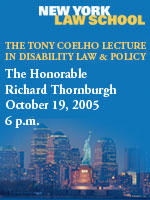 The information below is reproduced from the New York Law School's Labor and Employment Law Program's website - click here.
The Honorable Richard Thornburgh, former Governor of the State of Pennsylvania and Attorney General for the United States, will be delivering a major address at the New York Law School about issues associated with increasing the employment rate among people with disabilities. The Lecture will be held on October 19, 2005 from 6:15pm to 8:15pm in the Ernst Stiefel Room at New York Law School. A light dinner will be served to all attendees.
If you would like to attend, please click here to register to attend the event.
If you cannot attend the Lecture, please click here and register for the Live Webcast and watch Mr. Thornburgh's speech as he delivers it.
If you have any questions, please email lawoftheworkplace@nyls.edu or call Jamie Wenger at 212-431-2127.
Wednesday, September 21, 2005
Capitol protest
About five hundred disability-rights protesters from across the US visited the Capitol on Monday, organized by ADAPT; over a hundred of them were arrested for refusing to leave private offices, and some spent the night in jail. They targeted members of Congress who had not signed as co-sponsors of MiCASSA and other legislative efforts to combat the institutional bias in long-term care services. The story was widely if briefly reported in local television stations across the US (so there must be footage), and carried, again briefly, to newspapers by the AP (here's a shortlived link to that account, so read it quick). ADAPT's got a longer version, of course, with photos, here, and in this press release.
Sunday, September 18, 2005
Why celebrate?
Sigh. Commentator Rod Liddle in the Times of London thinks the public display of Alison Lapper Pregnant is about "the fashion for disability," which he considers a "delusional ideology," and asks, "Why would we wish to pay tribute to disability; if we're being honest, isn't disability bad, wouldn't we rather not have it at all?" The argument sounds very undergraduate. So let's walk him through it like an undergraduate, shall we? This argument is the same as saying that we shouldn't celebrate any minority experience, because it's just so much easier and more pleasant to be a member of the majority. Why celebrate being a woman? It's clearly so much more noble and exciting to be a man like, say, Admiral Nelson (whose Trafalgar Square statue is fine with Liddle--he lost the limb and eye in battle, so that's indisputably tribute-worthy).
Subscribe to:
Posts (Atom)

