Showing posts with label birthday. Show all posts

Wednesday, June 13, 2012

June 13: Infante Philip, Duke of Calabria (1747-1777)

Infante Philip, Duke of Calabria (1747-1777)
An 18c. portrait of a young blond boy, standing,
wearing ornate dress, and a red sash

Ever heard of the Infante Philip?  He had a lot of names.  He was born and baptized in the Kingdom of Naples, as Filippo Antonio Gennaro Pasquale Francesco de Paula.  His title from birth was Duke of Calabria, because he was the Heir Apparent of the Kingdom of Naples, son of the king.  He was named for his grandfather, King Philip V of Spain.  His birth was much heralded, coming as it did after five girl babies, in a world that valued sons, and especially firstborn royal sons, so much more.   A beautiful fan was painted to commemorate his birth.  But Philip would never rule a kingdom. 

Philip, son of King Charles, grandson of King Philip, was born with disabilities that became more apparent as he grew.  His head was large for his body; he had seizures; he did not learn to speak.  Witnesses said he didn't easily make eye contact.  He was raised with his siblings and tutored with his younger brother, Charles.  When Philip was twelve, a group of doctors and officials were charged with determining if he was competent to reign; they watched him for two weeks, and said no, Philip cannot fulfill that inherited role. 

So, as a young man, relieved of the right and obligation to be king, Philip, Duke of Calabria, lived in palaces at Capodimonte and Caserta.   He was not hidden; his regular public appearances were important for clarifying the reasons behind his younger brothers' positions.   He apparently enjoyed eating and drinking, and a particular quirk was mentioned in one account:  he enjoyed having gloves put on his hands--layers and layers of gloves, finger by finger, sometimes more than a dozen layers of gloves on each hand.  (I wonder what today's occupational therapists would make of that!  Was there a special case of Philip's glove collection, numbered by size, so they would nest just right?)  Into adulthood, palace staff had some difficulty keeping Philip from "embracing" women at the court; they tried to keep him away from women, but he learned to slip away. 

Philip, Duke of Calabria, died in the fall of 1777, from smallpox.  He was thirty.  He's buried in Naples, at the Church of Santa Chiara.  I wish I knew that when I visited Naples several years ago; I might have gone to pay my respects.


UPDATE April 2015:  I found a mention of Infante Philip in a 1770 Pennsylvania newspaper; evidence of how widespread knowledge of his disability was beyond Naples.

Tuesday, January 17, 2012

January 17: John Stanley (1712-1786)

[visual description: a portrait of composer John Stanley, apparently in middle age, wearing a white powdered wig and a brass-buttoned coat; his eyes are noticeably scarred]

Born on this date 300 years ago today, in London, English composer John Stanley (best click that link before or after Wikipedia goes dark on 18 January). Stanley was blind after a fall in early childhood. The boy turned out to be a musical prodigy while studying with the organist at St. Paul's Cathedral, and, at age 11, was appointed organist at All Hallows Church in Bread Street, a paid position. At fourteen he became organist at St. Andrews in Holborn, and at age 17 he completed a Bachelor of Music degree at Oxford.

Stanley married his copyist's sister, Sarah, a sea captain's daughter. He spent most of his career as organist to the Society of the Inner Temple. Handel was a frequent visitor to the church, to hear Stanley play. The admiration was returned: Stanley directed many Handel oratorios. Stanley's own baroque compositions were many and varied, from an opera to three volumes of organ music. (There are audio files of several Stanley compositions for organ at this site.) He was also elected governor of a Foundling Hospital, which mostly involved his advising the staff on hiring music teachers, and organizing fund-raising concerts.

Stanley's auditory memory and sensitivity were much remarked upon: it was reported that he never forgot a voice, and that he could judge the size of a room by sound. He also, apparently, had an adapted set of playing cards, with tactile markings at the corners, so that he could play whist with guests. Unfortunately for historians of such things, his family auctioned off all his possessions within weeks after he died, including his manuscripts and instruments.

Here's a YouTube video (which is really only a still image of an album cover) of John Stanley's Allegro (V) from Concerto op.2 no.1 in D Major:


I haven't discovered if there are any events marking his 300th birthday, but now we've marked it at DS,TU, anyway. And this early music editor blogger plans to produce some editions of Stanley's concertos this year.

BUT WAIT, THERE'S MORE!

In comments, Sue Schweik added the very exciting news that a UC-Berkeley musicology student, John Prescott, recently completed a dissertation about John Stanley.

Thursday, September 01, 2011

September 1: Phyllis Wallbank (b. 1918)

Born on this date in 1918, English educator Phyllis Wallbank. She worked with displaced children as a young woman in wartime London, and knew she wanted to find a way to make that her profession; a chance to hear Maria Montessori speak became the means to that end. Wallbank is one of the UK's best-known proponents of the Montessori method. In 1948 she opened Gatehouse School on the grounds of a church, and a major feature of the program was the inclusion of disabled children, at a time when few educational opportunities were available. Said Phyllis Wallbank (source):
"We incorporated mentally and physically challenged children at a time when they were normally segregated. We had groups of eight called 'families', each incorporating one disabled child. The child adapted to normality instead of to an institution. We eventually had all kinds of challenged children: children suffering from blindness, autism, maladjustment, thalidomide, Downs syndrome, cerebral palsy, brain damage and epilepsy. We had a social mix too: many children from professional families, some taking Common Entrance and public school scholarships and some local East Enders with parents known to have serious criminal backgrounds. And yet it all worked! Children were assisted and looked after by their friends and became an integral part of their "family". Often parents had no idea that a fellow student who came up in conversation at home was a disabled child."
Wallbank turns 93 today. Just a few years ago she went on an international lecture tour; one of her lectures in the US is on YouTube, in ten parts, here (there's no transcript, however).

Thursday, May 26, 2011

May 26: Moondog (1916-1999)

[above: Portrait of Moondog later in life, with long white beard]

I wondered how, as a blind man, he managed to cross the street without an instant of hesitation until he showed me how he listened to traffic lights; I had never heard them before in this way.

--Philip Glass, on fellow composer Moondog; from his introduction to Robert Scotto, Moondog: The Viking of Sixth Avenue (Process 2007).

Born on this date in 1916, street poet and composer Moondog, aka Louis Thomas Hardin. He knew he was a drummer from an early age, starting with cardboard boxes as a little boy, and drumming in the high school band. Young Louis became blind after a farm explosion at age 16; he left his local high school and studied music and composition at the Iowa School for the Blind. He learned to read braille, and devoured books on music theory; he moved to New York City in 1943.

Within a few years of his arrival in New York City, he took the name "Moondog," and was performing his own compositions on the street, often in a Viking costume of his own devising. He was influenced by the jazz scene, and by city sounds. Moondog created his own instruments to make the sounds he wanted to hear: an Oo and a Trimba, among the most notable inventions. ""Performing in doorways was the only way to present my music to the public, but for playing on the streets I needed drums down close to the ground, so I used to design my own instruments and had a cabinet- maker put them together," he explained. Much of his music was recorded, including a 1957 children's album featuring vocals by Julie Andrews.

In 1974 he moved to Germany, and lived there the rest of his life, composing, recording and touring. A German woman, Ilona Sommer, transcribed his braille notation and otherwise assisted him. After Moondog's death in 1999, Sommer became the administrator of his estate. Samples of his compositions turn up in popular recordings today, most recently a snippet of his "Bird's Lament" in Mr. Scruff's "Get a Move On." And there are quite a number of Moondog recordings to be found on YouTube; here's one for example:


[Description: There are no moving visuals here, just a photograph of an album cover called "More Moondog," which features a closeup of his bearded face, eyes closed.]

Wednesday, May 04, 2011

May 4: Marie Booth (1864-1937)

[visual description: a drawing of Marie Booth as a young woman, in profile, head bowed over folded hands; she has her hair in a low bun, and is wearing glasses and a high-collared jacket]

It's hard to imagine more formidable parents than Catherine and William Booth, the founders of the Salvation Army. Intensely religious and endlessly energetic in the pursuit of their causes, they had eight children, two of whom became "generals" in the Salvation Army. In fact, daughter Marie was the only one of the Booth children who didn't work for the Salvation Army.

Marian Billups "Marie" Booth, born on this date in 1864, had an illness (or, in some accounts, an accident) in early childhood that "rendered her too delicate to take her place beside her brothers and sisters in their public work" (Booth-Tucker, The Life of Catherine Booth (1872), p. 534). Her sister Evangeline recalled an incident from their childhood that will perhaps sound familiar to anyone with a close sibling:
My mother often said that our sister Marie, two years older than I, was her most beautiful baby. But at a very early age smallpox weakened her health and she could not profit by study as did the rest of us, nor in later years take part in public life. Being nearest to her in age, my mother asked me to make it my duty to help her with her lessons and see that she had a place in the games.

One day she failed to grasp the intricacies of a French translateion and our governess, becoming irritated, took hold of her beautiful hair and pulled her head first one way and then the other... and my small hand smote the cheek of the governess. I was ordered to bed without lunch or supper. ...

For two days I refused to say I was sorry for the reason I could not say so truthfully, after which my mother returned.... It might have been right to defend Marie but she was sure I was sorry for the way I had done it. I still wanted to say "No," but I caught the dimness in my mother's eyes and I replied, "Nearly." I was nearly sorry.

(From P. W. Wilson, General Evangeline Booth of the Salvation Army (1948), pp. 44-45.)
Marie attended public family events and held the rank of "staff captain" in the organization. She died in 1937, age 72, and was buried with her parents.

Wednesday, February 16, 2011

February 17: Marjorie Lawrence (1907-1979)


Born on this date in 1907, Australian soprano Marjorie Lawrence (show above in her wheelchair, smiling in a hallway for LIFE magazine; a man stands behind the chair; they appear to be dressed for a formal event).

Marjorie Lawrence was a noted performer of Wagner heroines. In 1941, while appearing in an opera in Mexico, she contracted polio. Eighteen months later, after treatment with Sister Elizabeth Kenny, she returned to the stage. Lawrence generally performed in a seated or reclining position thereafter, with creative staging that incorporated her stance into the visuals. The photo below, also from LIFE magazine, is from a performance by Marjorie Lawrence after polio (she played Venus--shell and all!). She taught after she retired in 1952, near her home in Hot Springs, Arkansas, until her death in 1979.
[Visual description: Black-and-white image of about eleven women in costume, on stage; the central woman, Marjorie Lawrence, lounges across a stylized throne-like shell, while the others around her are lounging or standing; there is a man in the foreground, crouching against the front edge of the throne/shell]

Saturday, January 15, 2011

January 16: Francis Kompaon (b. 1986)


[Video description: scenes of Papua New Guinea, including beaches, food markets; then we see Francis Kompaon, a dark-skinned young man in a red athletic jersey. There are interviews with him, translated by a voice-over in English, and scenes of him running, playing soccer, and walking in a market. He describes going to school and loving sports from a young age. There is also an interview with his coach, Bernard Chan. A woman's voice narrates the video, telling his history of achievements in competition, and his plans for the future.]

[How do I find the new captioning thing for YouTube videos? I've heard it exists, but this is the first time I wanted it.--PLR]

New Guinean athlete Francis Kompaon turns 25 today. He's a sprinter in the T46 category of paralympic competition--he was born without a full left arm. At the 2008 Paralympic Games in Beijing, Kompaon won the silver medal in the 100m event. Besides the personal achievement, Kompaon had earned the first Paralympic medal ever for Papua New Guinea--in fact, the first ever medal for that country at the Olympic level, period. The PNG government awarded him with funding to attend college in Australia, where he can access better training facilities.

Tuesday, January 04, 2011

January 4: George T. Dougherty (1860-1938)

[Image description: 19c. portrait of George T. Dougherty as a young white man, with dark hair and a full beard]

Who would have dreamed one hundred years ago that this could ever be possible? Then the deaf were uneducated and widely scattered, unknown to each other; their influence, of course, was nil.

--George T. Dougherty, at the 1893 World's Congress of the Deaf, as quoted in H-Dirksen L. Bauman, Open Your Eyes: Deaf Studies Talking (University of Minnesota Press 2008): 101.

Born on this date 151 years ago, in Franklin County, Missouri, chemist George T. Dougherty. He was deaf after surviving typhoid fever at age 2. Dougherty attended the Missouri School for the Deaf, and then Gallaudet College, where he earned undergraduate and masters degrees. Dougherty's specialty was industrial chemistry, mainly working in the steel industry in Chicago. He devised processes for determining the nickel and vanadium content of steel, and the salt content of petroleum. Dougherty was one of the founders of the National Association of the Deaf, chaired the World's Congress of the Deaf in 1893 (timed to coincide with the World's Fair in Chicago that year), and was a strong supporter of state schools and rigorous academics for deaf students (he and his wife were both state school alumni).

See also:

H. G. Lang, Silence of the Spheres: The Deaf Experience in the History of Science (Westport CT: Bergin & Garvey 1994).

Fina Perez, "Curriculum Guide for Discussing Deaf Scientists," Resources for Enhancing Science and Mathematics Education of Deaf and Hard-of-Hearing Students (website).

Saturday, December 18, 2010

December 18: Edward MacDowell (1860-1908)

[Visual description: 1940 US Postage stamp honoring Edward MacDowell, depicted as a mustachioed white man with a sweep of thick hair, wearing a stiff collar and tie.]

Today is the 150th anniversary of American composer Edward MacDowell, born on this date in 1860 in New York City (though some sources give 1861). He showed promise as a pianist from a young age; when he was 17, his family moved to Paris so he could study at the Paris Conservatoire. He also studied in Frankfurt, and played for Liszt, and taught in Darmstadt. He became a music professor at Columbia University first chairman of the Music Department there, and was a prolific composer. In 1904, he was part of the first group of honorees named to the American Academy of Arts and Letters.

But also in 1904, at age 44, he was run over in a streetcar accident, and his injuries apparently accelerated a progressive neurological condition. He was unable to continue composing or teaching. "His mind became as that of a little child," said Lawrence Gilman, a friend. "He sat quietly, day after day, in a chair by a window, smiling patiently from time to time at those about him, turning the pages of a book of fairy tales that seemed to give him a definite pleasure, and greeting with a fugitive gleam of recognition certain of his more intimate friends." Composer Edvard Grieg ascribed the trouble to MacDowell's remarkable artistic temperament and an "unusually sympathetic and sensitive nervous system": "An artist so ideally endowed as MacDowell must ask himself: Why have I received from nature this delicately strung lyre, if I were better off without it?" (letter quoted in Gilman's biography, p. 35)

There was certainly an awareness of brain injuries at the time, and of dementia, but little was available in the way of medical intervention or rehabilitation, and there was no economic safety net for him or his wife, either. Friends held fundraisers and prominent authors and musicians signed calls for support. MacDowell's wife Marian, herself a musician, refused to consider an institution, and cared for him at home (assisted by a nurse, Anna Baetz) for the three years until he died.

In fulfillment of their shared vision, Marian founded an artists' retreat, the MacDowell Colony at her farm in New Hampshire in 1907. Marian MacDowell (d. 1956) led the Colony for twenty-five years, funding it with her lectures and performances, mainly for women's organizations. Nurse Anna Baetz (d. 1923) stayed on, long past Edward's passing, to help with the colony's day-to-day running. Today, the MacDowell Colony can claim dozens of award-winning works of art that were written or begun at the Edward and Marian's farm.

Monday, October 25, 2010

October 25: Grace Padaca (b. 1963)

"I am Grace Padaca. I share my story because I know there are many who are like me, not big people, not rich, not strong. I know there are many like me whose strength is inside."

--from a campaign appearance by Grace Padaca
Above: Gracia Cielo "Grace" Magno Padaca, former Governor of Isabela Province in the Philippines, standing on a stage while a group of other people are seated in a row behind her. Padaca was elected governor in 2004, was reelected in 2007, and was defeated in another bid for reelection, earlier this year.

Padaca survived polio in her early childhood, and uses crutches (seen in the photograph above). Padaca was valedictorian of her high school class and graduated with highest honors from college. Before politics, she worked as a radio journalist. In 2008, she won the Ramon Magsaysay Award for Government Service. Today is her 47th birthday.

Friday, August 13, 2010

August 10: Hugh Morriston Davies (1879-1965)

I wrote this post last weekend, planning to put it up on Tuesday the 10th. Obviously other matters became more urgent. So I'm going to put this up now. --Ed.

You know the plotline if you've seen any medical dramas on TV: A gifted surgeon is in an accident, or maybe the victim of a crime, or perhaps falls very ill. He (it's usually a "he") survives, but....gasp! his hand! Injured beyond repair. He can never do surgery again. Might as well forget medicine as a career.

Or not.

Welshman Hugh Morriston Davies (1879-1965) lived this drama, but with a very different outcome. He was, certainly, a gifted and pioneering thoracic surgeon in London in the 1910s. By age 27 he was a fellow of the Royal College of Surgeons. He was the first surgeon to detect lung cancer by x-ray. He "performed the first anatomical dissection lobectomy for a tumor of the lung in 1912... decades ahead of his time," according to medical historian AP Naef. But in 1916, during an operation, his right hand was cut by a stray sliver of glass. It became seriously infected, and amputation was urged (but not undertaken). He lost all effective use of his right hand.

For a time, he ran a sanatorium in Wales, and worked on a book about thoracic surgery, and wrote journal articles. But in 1921 he returned to surgery, using his left hand. His sanatorium became a destination for thoracic surgical training, and Morriston Davies a respected expert on tuberculosis. During the second world war he ran a "chest unit," treating the military and civilian chest injuries. Even after his retirement at 80, he sought adaptive innovation: he set up a series of pullies to allow him to garden when his legs wouldn't carry him.

His obituary from the British Medical Journal is long and informative.

Tuesday, June 15, 2010

June 15: Ana Castillo (b. 1953)

[Visual description: book cover for "Peel My Love Like an Onion" by Ana Castillo; a woman's face in flamenco-dancing costume is partly hidden by a fan]

"A friend suggested that I see a doctor, as if a doctor could give me a new leg, another spine, make me fifteen years younger. The doctor sent me to a therapist who then advised me to take a ceramics course at City College to channel all that creative fire burning inside me."

--Carmen Santos, the narrating character in Ana Castillo's Peel My Love Like an Onion (1999)

American novelist Ana Castillo was born on this date in 1953, in Chicago. Her character Carmen "la Coja" Santos or "the cripple" (Carmen la Coja is the Spanish title of the novel) is also born in Chicago in the 1950s, and survives a childhood bout with polio to become a "gimp flamenco dancer." In her forties, a series of setbacks including post-polio symptoms sets the character on a mid-life project of resetting priorities. More here about the "trope of disability" in Castillo's novel and others.

See also:
Suzanne Bost, Encarnación: Illness and Body Politics in Chicana Feminist Literature (Fordham University Press 2009).

Monday, May 10, 2010

May 10: John Louis Clarke (1881-1970)


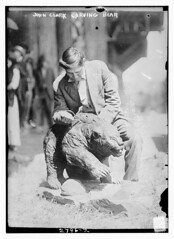
John Clark Carving Bear (LOC)
Originally uploaded by The Library of Congress

Born on this date in 1881, woodcarver John Louis Clarke, aka "Cutapuis." He was born in Highwood, Montana Territory, to Blackfoot parents (one of his grandparents was Scottish). The family was devastated in 1883, when five sons died from scarlet fever; the sixth son, John, age 2, survived with deafness; he did not learn to speak after that. He attended schools for Indian and deaf children in North Dakota, Montana, and Wisconsin. In Wisconsin, he began working at a factory that made carved church altars. He opened his own carving studio in 1913, and had his first show in Helena in 1916.

Clarke's highly detailed carvings of animals were exhibited widely and popular with buyers. Clarke's wife Mamie acted as his agent until she died in 1947, when their daughter Joyce took over that role so Clarke could concentrate on his carving. The story goes that he had his carving tools with him in the hospital room when he died at 89.

Friday, April 30, 2010

April 30: Juhan Liiv (1864-1913)

[visual description: portrait of poet Juhan Liiv as a young man, he appears to be fair-haired with light eyes; his expression is serious]

When I was only a little boy
A ringing was ringing in my mind.

And when I grew older
The ringing went louder.

Now I am almost buried in it,
My bosom is ruined under it,

My spirit and life are ringing sounds - Too cramped for them are earthly bounds!

--"Ringing" by Juhan Liiv (1910), as translated here


Estonian poet Juhan Liiv was born in this date in 1864, in the village of Alatskivi. He struggled with mental illness as a young man, and had trouble holding a job. His first story, "The Shadow," was published when he was thirty, and remains a classic of Estonian literature. But by the time it was published, he was staying at a clinic in Tartu, and was diagnosed with schizophrenia. A literary editor found his work and a volume of almost 500 poems by Liiv was published in 1909. Some of this poetry reflects Liiv's feelings of doom and fear, and his experiences as a poor and misunderstood man; other pages contain romantic or patriotic verses that found an appreciative audience.

Liiv died from pneumonia in winter 1913, after being thrown off a train (he didn't have a ticket, and unfortunately he didn't take his coat when he was ejected in a remote area). Today, Liiv is considered one of the finest poets in Estonian literature. His grave in his home village has a handsome marker, and the farm where he was raised is now a museum. Some of his writings have been set to music. Alatskivi also offers an annual Juhan Liiv Prize for Poetry.

Monday, March 15, 2010

March 15: Sue Boyce (b. 1951)

[Visual description: family portrait of Australian senator Sue Boyce, who is shown with her three adult children, two women and a man; one of the daughters has Down Syndrome. All are smiling and embracing each other.]

"Anytime we allow people with a disability to be treated as special people who should live or learn or work or spend their leisure time in special places, we are shutting people with a disability out of the mainstream."

Happy birthday to Australian senator from Queensland, Sue Boyce, who has made disability rights issues a priority of her legislative work. She's currently serving on the committee to consider Australian immigration laws on the subject of disability. She is also a past president of the Down Syndrome Association of Queensland. Last week, she called a controversial decision of the Family Court in Brisbane concerning the sterilization of an 11-year-old disabled girl "appalling....completely discriminatory and inhumane."

Tuesday, February 16, 2010

16 February: Theresa Goh (b. 1987)

[Visual description: A photograph of swimmer Theresa Goh, wearing a black competition suit and swimcap, sitting in a wheelchair, smiling]

"I'm fine with it. I [wouldn't] be swimming or where I am today if I weren't disabled."
--Theresa Goh

A sports birthday today--and a summer sport, in case you've had quite enough snow and ice by now, on TV or out the window (or both).

Singapore's Theresa Goh Rui Si was born on this date in 1987. She was premature, and had spina bifida that required surgery in her first months. Goh has always used a wheelchair. At age 5, she started swimming, and by age 12 she was swimming in meets. Since her teens, she's been a world-class swimmer in Paralympic events. She won in four different events at the Danish Open in 2007; at the Paralympics in Beijing the next year, she competed in four events and was her team's flagbearer. This past December, she earned a gold medal at the IWAS World Wheelchair & Amputee Games in India. She's planning to train for the 2012 Paralympics in London.

Goh turns 23 today.

Saturday, January 23, 2010

January 23: Django Reinhardt (1910-1953)

[Visual description: Django Reinhardt, in a black-and-white photo, holding his guitar, with a cigarette in his lips]

One hundred years ago this weekend, guitarist Django Reinhardt was born, outside the town of Liberchies, Belgium, in a Roma family. The teenaged Django found work playing music in a Paris dance hall. But at 18, the caravan he shared with his first wife caught fire. He was burned, with especially bad burns on two fingers on his left hand and his right leg. Reinhardt walked with a cane eventually, and returned to the guitar by making adaptations around his burned fretting hand. The result was a distinctive sound, and a legendary career in jazz.

See and hear a snippet of Reinhardt playing in this YouTube video from 1945 (the visuals also include people dancing, boxes being unloaded from a truck, and ration coupons being clipped).

Sunday, January 10, 2010

January 10: Johnnie Ray (1927-1990)

[visual description: Singer Johnnie Ray in front of a large microphone with the words "Columbia Records" on it; Ray has his eyes closed, his mouth open, and his hands on his head, in a pose that seems meant to convey absorption in his singing.]

Born on this date in 1927 was John Alvin "Johnnie" Ray, an American singer popular in the 1950s. Ray was born and raised in Oregon. As a boy, Ray was participating in a "blanket toss" activity at a Boy Scout Jamboree when his right eardrum was damaged and he became deaf on that side. He lost more hearing during a surgery in 1958. (Some biographies say that Ray had some hearing loss before the jamboree event, as well.)

Ray performed wearing a visible hearing aid (check out this video for example, which begins with Ray facing away from the camera, with the back of his right ear in the spotlight); it can be seen in some publicity stills, but in others it is not included. Road manager Tad Mann attributed the singer's distinctive sound and highly animated performance style to his concern for pronouncing words clearly and communicating through facial expressions and body language.

While Ray was "out" about being a deaf man, he struggled in an era when homosexuality was criminalized. He was arrested, tried, and fined several times in the 1950s for minor incidents related to his sexuality. He experienced alcoholism and drug addiction for decades, and died from liver failure in 1990.

Further reading:

Cheryl Herr, "Roll-over-Beethoven: Johnnie Ray in Context," Popular Music 28(3)(2009): 323-340.


Tuesday, January 05, 2010

January 5: Thomas Pringle (1789-1834)


[Image description: engraved head-and-shoulders portrait of Thomas Pringle as a young man, balding, with long sideburns and a high-collared white shirt, head resting on one hand.]

Scottish poet, editor, and abolitionist Thomas Pringle was born on this date in 1789, on a farm in Blaiklaw, Roxburghshire. As a baby, his hip became dislocated, and the dislocation went untreated; Pringle used crutches throughout his life thereafter. From his memoirs:
"My early reminiscences reach back to a period when I must have been about three years old, or little more. I remember of being carried to Kelso when about that age, and being tormented by doctors examining my limb, and making me wear a red morocco boot, with steel bandages to keep it in some prescribed position. These appliances were of no advantage, and were, ere long, superseded by a pair of crutches. The latter I soon learned to use with such ease and adroitness that, during my boyhood and youth (when I generally enjoyed robust health), I felt but little incommoded by my lameness."
Pringle's later adventures included a six-year stint as a librarian in South Africa, where he was an early publisher of English-language news and literary publications. His work in publishing and abolition led to his role as the recorder of Mary Prince's narrative, which was published in 1831. Pringle died three years later, from pneumonia, age 49.

Friday, January 01, 2010

January 4: James Nack (1809-1879)

Poet James M. Nack was born 4 January 1809, and wrote a poem for New Year's Day for his daughter Eveline:

A New-Year's Greeting to my Daughter (1859)

So it is gone! -- another year!
A drop of time lost in the sea
Of dark and deep eternity,
In which we all must disappear!
Well, since so transient our career,
The blessings that attend the way
More precious grow with every day:
So is it with my EVELINE,
And ever was since she was mine;
Since first she nestled on my breast,
And on its beatings rocked to rest;
And when her little arms at length
To twine around me gathered strength,
And her young eyes replied to mine
With love's intelligence divine;
When first her lips began to frame
Sweet murmurings of a father's name;
Or with more eloquence of love
Those rosy lips to mine were prest--
Oh, closer still I clasped my dove,
And could have died so very blest!
....

Nack, a lifelong New Yorker, was deaf after a serious head injury when he was nine years old. He was among the first successful alumni of the New York Deaf and Dumb Asylum, which he attended from 1818 to 1823. He worked in the office of the Clerk of the City of New York for many years, and frequently contributed poems to the New York Mirror. He published several volumes of verse, starting with The Legend of the Rocks and Other Pieces (1827). Much of his poetry celebrates his happiness in family life--he married in 1838 and was the father of three daughters (including Eveline, above). Nack also did translations from French, German, and Dutch. Several books of Nack's poetry are available in Full view on Google Books (The Romance of the Ring, Earl Rupert, and The Immortal, for three).

For further reading, see:

Christopher Krentz, ed., A Mighty Change: An Anthology of Deaf American Writing 1816-1864 (Gallaudet University Press 2000).

John Lee Clark, ed., Deaf American Poetry: An Anthology (Gallaudet University Press 2009).