Two big projects in US disability history are launching into the world today:
Today's the release date of Kim Nielsen's A Disability History of the United States (Beacon Press 2012), a concise (272 pages!), inexpensive (just $16 in hardcover!), and sweeping account, starting before 1492, and landing in the present-day. If this is exactly the book you've needed for a class, for a book group, for your own study, you're not alone. I've only been reading in disability history for seventeen years, but back in the 1990s, you'd be lucky to find a text that even acknowledged the existence of disability before Samuel Gridley Howe's 1848 report to the Massachusetts legislature. (All my graduate projects had colonial and Early Republic settings, so I noticed.) So for that aspect alone, let alone all the other goodness involved, I'm thrilled to greet this book.
Also--DVR alert--start popping the popcorn and dimming the lights! Tonight is the first night of Turner Classic Movies' month-long feature, "The Projected Image: A History of Disability in Film." More than twenty films, various eras and genres, all with disability themes, airing all five Tuesdays in October. Lawrence Carter-Long will co-host the series with Ben Mankiewicz. Tonight's lineup: An Affair to Remember (1957); Patch of Blue (1965); Butterflies are Free (1972), Gaby-A True Story (1987), and The Sign of the Ram (1948). All with closed captions, all with audio description. It's a big deal that a cable network is devoting this much time to disability history and culture, and to make it accessible too; if you don't get TCM, consider calling your cable company and just subscribing for October. That'll be great for you (20+ movies on disability themes, plus the rest of their lineup), and it'll send a signal that this kind of programming is appreciated.
Also, if anyone wants to see a discussion feature here on DSTU, for either Kim Nielsen's book, or the TCM Film Series, I'm game. Just holler in comments, and I'll be glad to set that up. Otherwise, the hashtag for twitter discussions of the film series is #ProjectedImageTCM, and TCM has its own discussion boards that are certainly available for the purpose.
ETA: Here's a podcast interview with Kim Nielsen about the new book.
Tuesday, October 02, 2012


Monday, September 17, 2012
CFP: Disability and the American Counterculture
Spotted on DS-HUM:
Special issue CFP: Disability and the American Counterculture
Guest edited by Stella Bolaki and Chris Gair
The American Counterculture has a complex relationship with disability. At
its heart is the reinvention of the term freak that serves as an early
example of empowering, though not unproblematic, appropriation of what had
previously been a derogatory term. Freak Out!, the debut album by The
Mothers of Invention—labelled a “monstrosity” by Frank Zappa—is a prime
example of the association of freakery with the forms of avant-garde
experimentation representative of one form of countercultural practice. In
addition, representations of disability and illness occur repeatedly in
countercultural work: the asylum and hospital become central tropes for
examinations of the relationship between sanity and madness in Allen
Ginsberg’s “Howl” and Ken Kesey’s One Flew Over the Cuckoo’s Nest, while
canonical Beat/countercultural novels such as Jack Kerouac’s Desolation
Angels and Richard Brautigan’s Trout Fishing in America and movies such as
Richard Rush’s Psych-Out feature disabled characters not only to derive
rhetorical force in their critique of hegemonic culture, but also to
question core countercultural ideologies. In terms of aesthetics, William
Burroughs’ experimental “cut-up technique” has been discussed in the
context of his interest in virology and Andy Warhol’s work of trauma,
injury and violence alongside what Tobin Siebers has called “disability
aesthetics”. More recent work, such as E.L. Doctorow’s novel Homer and
Langley, the Hollywood film Forrest Gump and Simi Linton’s memoir My Body
Politic, examines the connection between disability and the counterculture
through different lenses and with various aims.
What do perspectives informed by disability studies have to offer to
typical readings of the American counterculture and its fundamental ideals
of movement (both geographical and ideological), youth and vitality? In
what ways did the American counterculture and the disability movement
approach notions of the “normal” and the “abnormal” body? Beat and
countercultural writers and artists have been criticised for their
romanticised view of other cultures and for appropriating and shedding
roles and personas from various marginalised groups at a dizzying pace. How
different was the appropriation of disability to the American
counterculture’s interest in other cultures (Eastern, African American,
Native American) and their potential for constructing a subversive
identity? What are the legacies of the American counterculture and its
various discourses and styles of liberation for contemporary disability
life writing, arts and activism? With such questions in mind, the co-
editors invite proposals on an array of topics which include (but are not
limited to) the following:
•perspectives from disability studies/theory on iconic as well as
understudied Beat texts and countercultural ideals more broadly
•challenges to “normalcy” from disability movements and the American
counterculture (comparative perspectives/debates)
•disability as theme and/or aesthetic in countercultural writing, art, film
and music or in more recent works that reference the American counterculture
•appropriation and reinvention of the term “freak” by the counterculture
•approaches to spectacle, the stare, the performative, and fashion in
American counterculture and disability cultures/arts
•disability in the sixties-era communes and communal living groups
•feminist disability studies and the counterculture
•crip perspectives on the American counterculture
•legacies of the American counterculture and countercultural ideals,
practices and styles for disability writing, arts, and activism
Discussions of specific literary and cultural texts are invited, but
preference will be given to projects that use individual texts as vehicles
to address broader cultural debates and theoretical inquiries related to
disability studies and the American counterculture. A one-page proposal and
a one-page curriculum vitae should be emailed to S.Bolaki@kent.ac.uk and
Chris.Gair@glasgow.ac.uk by the end of July 2013. Finalists will be
selected by 1st October 2013, and full drafts of articles will be due on
1st March 2014.
Thursday, September 13, 2012
Lecture series: Disabilities and Abilities in the Middle Ages & the Renaissance
Starting last week, the Center for Medieval and Renaissance Studies at Ohio State University is offering a series of ten free public lectures on disability in the Middle Ages and the Renaissance. I'm not in Ohio, and I'm guessing a lot of our readers aren't either, but it's still interesting to see the lecture titles (links lead to each lecture's facebook event page, for further information):
Friday, 7 September 2012
Christine Lee, Lecturer in Viking Studies, Nottingham University
"Able Bodies: Considerations of (Dis)ability in Anglo-Saxon England"
Friday, 28 September 2012
Paul Hyams, Professor of History, Cornell University
"Serfrom without Strings: Amartya Sen in the Middle Ages"
Friday, 12 October 2012
Julie Singer, Assistant Professor of French, Washington University in Saint Louis
"Mental Illness, Self-Violence, and Civil War"
Friday, 16 November 2012
John Lindow, Professor of Scandinavian, UC-Berkeley
"Maimed Bodies and Broken Systems in the Old Norse Imaginary"
Friday, 30 November 2012
Shigehisa Kuriyama, Reischauer Institute Professor of Cultural History, Harvard University
"Toward a History of Distraction"
Friday, 8 February 2013
James Clifton, Museum of Fine Arts, Houston
"Blindness, Desire, and Touch in Two French Paintings"
Thursday, 21 February 2013
Michael Thomsett, Independent Scholar, Author of The Inquisition: A History
"Legal Disabilities of Inquisition Victims"
Friday, 8 March 2013
Encarnación Juárez-Almendros, Associate Professor of Spanish, University of Notre Dame
"Teresa of Avila and her Neurological Condition"
Friday, 22 March 2013
Christopher Baswell, Ann Whitney Olin Professor of English, Barnard College/Columbia University
"Three Medieval Cripples: The Performance of Authenticity"
Friday, 12 April 2013
Ian Maclean, Professor of Renaissance Studies, All Souls College, Oxford
"Renaissance Bodies and their Imperfections"
Friday, 7 September 2012
Christine Lee, Lecturer in Viking Studies, Nottingham University
"Able Bodies: Considerations of (Dis)ability in Anglo-Saxon England"
Friday, 28 September 2012
Paul Hyams, Professor of History, Cornell University
"Serfrom without Strings: Amartya Sen in the Middle Ages"
Friday, 12 October 2012
Julie Singer, Assistant Professor of French, Washington University in Saint Louis
"Mental Illness, Self-Violence, and Civil War"
Friday, 16 November 2012
John Lindow, Professor of Scandinavian, UC-Berkeley
"Maimed Bodies and Broken Systems in the Old Norse Imaginary"
Friday, 30 November 2012
Shigehisa Kuriyama, Reischauer Institute Professor of Cultural History, Harvard University
"Toward a History of Distraction"
Friday, 8 February 2013
James Clifton, Museum of Fine Arts, Houston
"Blindness, Desire, and Touch in Two French Paintings"
Thursday, 21 February 2013
Michael Thomsett, Independent Scholar, Author of The Inquisition: A History
"Legal Disabilities of Inquisition Victims"
Friday, 8 March 2013
Encarnación Juárez-Almendros, Associate Professor of Spanish, University of Notre Dame
"Teresa of Avila and her Neurological Condition"
Friday, 22 March 2013
Christopher Baswell, Ann Whitney Olin Professor of English, Barnard College/Columbia University
"Three Medieval Cripples: The Performance of Authenticity"
Friday, 12 April 2013
Ian Maclean, Professor of Renaissance Studies, All Souls College, Oxford
"Renaissance Bodies and their Imperfections"
Tuesday, September 04, 2012
Disability Blog Carnival #84: Call is up now...
Writer in a Wheelchair is hosting the September edition of the Disability Blog Carnival. Because Emma's been at the the Paralympics recently, the theme will be "Inspire a Generation." Here's the call, and here are the main details:
You can submit older posts or write new onesEmma lists several ways to submit links--in comments at the blog, in tweets, and in emails. Please consider joining in!
They need to be related to disability but don’t need to be written by disabled people
Posts need to fit the theme in someway but it’s not rigid
The deadline for posts is Sept 26th, I hope to post the carnival on 30th Sept.
Wednesday, August 22, 2012
An ironic way to celebrate the ADA
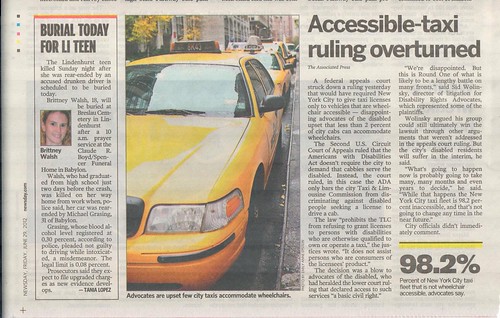
A very vocal group of disability activists (including several Disability Studies scholars) turned up for an early August party at New York Mayor Blumberg's Gracie Mansion residence in Manhattan. Barred from making their feelings known regarding the city leadership's tepid support for the Americans with Disabilities Act, the protesters gathered outside and blocked the street outside the mansion for their own form of "celebration."
According to AP News, after the Second U.S. Circuit Court of Appeals ruled that the Americans with Disabilities Act did not require the city to demand that cab companies serve people with disabilities, Mayor Blumberg lent his own wholehearted support for the decision.
Through strategic CNN iReport, Google+ and Facebook posts we learned that four of the protesters were arrested outside the August 9th ADA anniversary party. The sight of them being hauled away was itself ironically telling: since the police department did not not have any accessible paddy wagons. the four protesters had the loaded onto Access-A-Ride vans.
Tuesday, August 07, 2012
CFP: VariAbilities (4-7 July 2013, Emory University)
From DS-Hum:
VariAbilities: A conference on the history and representation of the body in its diversity
Emory University
4-7 July 2013
It is no longer useful to distinguish people by the binary opposition able-bodied/disabled. We now recognize people on a continuum of ability on which no-one is entirely able-bodied or entirely disabled. But was it always true? And if it is true now, does this require that we reconsider the use of binary oppositions when understanding people and their capabilities? VariAbilit(ies) is an interdisciplinary conference which will explore these questions. It will focus on the body and how it was treated and represented throughout history. Subject areas will include: Literary representations The Asylum The History of Poor Relief Gender/ Sexuality Disability and Aesthetics Disability and Race And anything else you are interested in
Please send abstracts (300 Words by 30 October 2012) to:
Chris Mounsey University of Winchester chris.mounsey@winchester.ac.uk
Paul Kelleher Emory University pkelleh@emory.edu
The CFP on Facebook.
Conference announcements on Twitter.
Thursday, July 26, 2012
Disability in the Presidential Campaign of 2012: Abram Powell
Saw this ad/video today from the Obama campaign, featuring Abram Powell, a deaf African-American auto worker from Michigan. I like how specific it is to his life--it's not a generic disability message--and it's full of photos, and we see him speaking to an audience in ASL, etc.
Seen other ads, from any campaign, that focus on disability themes? Drop a link in comments.
Seen other ads, from any campaign, that focus on disability themes? Drop a link in comments.
Subscribe to:
Posts (Atom)

