Mike beat me to the mentioning of Katrina here, but in this entry I'll take a tour 'round what disability blogs and lists are saying on the subject. Susan Fitzmaurice has set up a website to collect information about relief services for people with disabilities here, and it already has a wide array of contact details (you can target donations to independent living centers, or the transportation of emergency wheelchairs and personal supplies, etc.). It's also a place where people who have accessible homes of various kinds, even in other states, are offering emergency shelter. (Did I Miss Something? has some targeted donation details along the same lines.) At Quiescent Voices, there's a post about the need for ASL interpreters at the Red Cross shelters for Katrina refugees. The Angry Gimp is, like a lot of people, angry about the disproportional effect of the disaster by race, class, age, and ability, and collected some news clips about the current perilous conditions for people with disabilities. The Rolling Rains Report has a recent press release from the National Organization on Disability on disaster preparedness and people with disabilities.
Added soon after posting: Mary Johnson's got more links , some commentary, and news that the Ragged Edge site will also be posting details about relief targeted at refugees with disabilities as they become available.
Added the next day: Kestrell's got an entry titled "Living on the Edge of the World," musing on how tenuous "safety" is. "We like to think we live in families, communities, religious groups, cities, states, governments, which consider us valuable enough to lift a hand to save us, or at least reach out a hand to comfort us when nothing else can be done," she writes. But for too many in New Orleans, she continues, it's clear that no rescue, no comfort came.
Katrina
Friday, September 02, 2005


An invitation to post (Katrina)
I hope that readers of this blog will use this as a stem to post their thoughts on the inadequate disaster preparedness for New Orleans' long feared 'Big One.' When drilling for this kind of hurricane impact, the needs of New Orleans poor, inform and disabled populations were never brought to the foreground. How were people living check to check on public assistance supposed to pay for transportation out of their soon to be submerged neighborhoods? Who was looking out for their best interests? Geographers like Craig Colton have been warning about these dire possibilities, but unfortunately have not been in a position to affect policy. See my further thought on the unfolding Katrina disaster here and in the comments fields to posts placed here.
Update, 4:11 pm - The Association of American Geographers (AAG) will be establishing an information clearinghouse and fund to help geography departments affected by Hurricane Katrina. More information here.
Katrina
Update, 4:11 pm - The Association of American Geographers (AAG) will be establishing an information clearinghouse and fund to help geography departments affected by Hurricane Katrina. More information here.
Katrina
Tuesday, August 30, 2005
Disability History Image #3
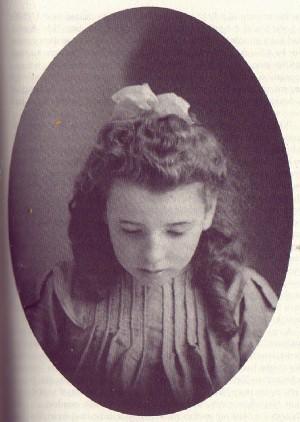 This photo is found in Esther Lanigan's Mary Austin: Song of a Maverick (Yale University Press 1989). It's a photo of Ruth Austin (1892-1918), writer Mary Austin's daughter, taken in Santa Clara, CA, just before she was placed in a "nervous hospital" in that same town, in 1904. There is at least one other image from this photo session, at the Huntington Library (Austin Papers), showing Ruth looking off-camera to the viewer's right.
AutismDiva has posted a some historical portraits recently (Someone's Cousin Moe, Antique Autistics), in the interest of combating the widespread belief that autism was somehow "new" in the late 20th century. In the case of Ruth Austin, we have a glimpse of how her behavioral characteristics appeared to Helen MacKnight Doyle, a physician friend of Austin's, years before Ruth was institutionalized. She described the "beautiful" child's "restless uncertain movements of her small hands," "strange sounds," and "passionate, ungovernable spells." It seems likely that she would have an autism diagnosis today. At the time, she was most often labeled "hopeless."
Ruth Austin was placed in Dr. Antrim Osborne's small Santa Clara hospital in 1904. According to the 1910 US Manuscript Census returns, the hospital had nine on-site staff members (including Osborne and his wife, two nurses, a teacher, a waitress, a housekeeper, a male attendant, and a cook--the cook was Chinese-born, all the rest were born in the eastern US). Ruth was, in 1910, one of 22 inmates, all white, male and female, mostly US born and under 40. Five of the inmates under 18, including Ruth Austin, are listed as having attended school in the preceding year.
Mary Austin never visited her daughter at the Osborne hospital, as medical advice in the day said parents would interfere with their child's treatment in such institutions. In fall 1918, Ruth Austin died in the worldwide influenza epidemic, at the age of 26.
Cites: I haven't published anything directly about Ruth Austin, but I have a book chapter out there that touches on her story: "Bad Blood and Lost Borders: Eugenic Ambivalence in Mary Austin's Short Fiction," in Lois A. Cuddy and Claire Roche, eds., Evolution and Eugenics in American Literature and Culture, 1880-1940 (Bucknell University Press 2003). Dr. Antrim E. Osborne is mentioned and quoted in James W. Trent Jr.'s Inventing the Feeble Mind: A History of Mental Retardation in the United States (University of California Press 1994): 83, 90-91. Helen MacKnight Doyle's biography of Mary Austin is Mary Austin: Woman of Genius (Gotham House 1939).
Monday, August 29, 2005
Drivers' Licenses for Motorized Wheelchairs?
I almost checked the date to be sure it wasn't 1 April when I read this story from Bristol (UK). As the author comments, "And what next? Perhaps they'll suggest we should go back a century and have someone waving a red flag as the motor wheelchair travels down the road."
Friday, August 26, 2005
Accessibility competition
The headline of this Lawrence Journal-World story, "KU teams take top spots in national disability contest," is a bit puzzling--what's a disability contest?--but it turns out to be a story about "Access to Fun," a competition in which teams of engineering students at various universities were challenged to design amusement park rides with accessibility in mind. First, second, and third place in the competition were won by teams from the University of Kansas School of Engineering. Here's a press release about "Access to Fun" from one of the competition's co-sponsors, the International Association of Amusement Parks and Attractions.
Should Kirsten Johnson be allowed to have kids?
BY KATIE WATSON, August 21, 2005
Vera Howse thinks her 26-year-old niece Kirsten Johnson wouldn't be a good mother, so she's asked the Cook County Probate Court for authorization to sterilize her niece against her will. Johnson is cognitively impaired, and her aunt is her legal guardian.
This case has broad significance because Illinois, unlike other states, hasn't established when a court should grant a guardian authority to have a ward permanently sterilized.
Most cases like this are resolved in the doctor's office. Physicians at one Chicago hospital system estimate that it receives one to three guardian requests to sterilize their wards per month, usually from parents of disabled adolescents. After counseling, most eventually opt instead for long-term reversible birth control.
But in this case Howse continued to insist that her niece be sterilized permanently, and her internist and psychiatrist did not object. Johnson countered by contacting Equip for Equality, a disability rights organization that represented her in court. Johnson, who lives with her aunt in south suburban Matteson, is sexually active. She has always used birth control (her aunt currently helps her use the patch), but says if she were to marry a man who could help her parent someday, she would like to have a child.
Historically speaking, Johnson's situation isn't unique. State programs forced up to 70,000 disabled and poor Americans to be sterilized between the early 1900s and the 1970s. These programs, now ended, were driven by a belief that social eugenics would both "improve the gene pool" and save the taxpayers money by reducing the number of children born to parents who couldn't support them.
The courts were no help. In Virginia, for example, the Lynchburg Colony for the Epileptic and Feeble Minded, which sterilized 8,300 people from 1927 to 1972, was a model of empty due process. The disabled and poor teens forcibly brought to the institution were given a perfunctory hearing, after which a judge would always find it was in the "best interests" of the patient and society that the ward not reproduce. In 1927 the Supreme Court upheld this Virginia statute in the case of Buck v. Bell.
Six years later, the Nazi regime in Germany modeled its new eugenic program on U.S. sterilization statutes. They began with the sterilization of disabled individuals in 1933, later executing thousands of persons with disabilities and millions from other "unfit" populations.
Whose 'best interest'?
But things are different now, right? States have formally apologized for their eugenics programs, the Americans with Disabilities Act ushered in a new era of accommodation and respect, and the disabled person's right to medical self-determination is implemented by his or her guardian, who is usually a family member concerned with the disabled person's "best interests." At least that's the standard Illinois law tells guardians to use.
The problem is that childbearing is one decision in which what's best for the ward and what's best for the guardian might conflict. While some cognitively impaired people might enjoy parenthood, their guardians may fear a new baby will become the guardian's responsibility. Or, in the case of congenital disability, guardians may fear the ward will "pass on their genes" and bear another disabled family member. Ironically, these criteria -- resources and eugenics -- are exactly those used by the now-discredited state programs.
What standard should Illinois courts use to resolve cases like Johnson's? To be blunt, families give up a lot to care for a cognitively impaired child. Is it so wrong to ask the disabled individual to give up the right have children in return? Might this be a fair exchange?
Absolutely not. The law says no person's reproductive options are contingent on the needs, desires or judgment of another. Why should persons with disabilities be the exception? No parent is allowed to control whether their child bears a grandchild, even when they're a minor (legally "incompetent").
Wives can give birth and have abortions against their husband's wishes. And the Supreme Court has ruled that criminals can't be sterilized as part of their punishment.
Reproductive freedom holds such a cherished place in our society that even the welfare of the potential child does not trump it. The state cannot prevent an abusive, drug-addicted person who has lost eight children to foster care from procreating.
But Judge James Riley sees this case differently. In his Aug. 11 decision, he ruled that it is in Kirsten's best interest 'to have a permanent form of birth control. Why? Because several people testified that she would not be able to care for a child alone.
This sounds like a "parental litmus test" to me. I'm not applauding irresponsible parenting, but making people with disabilities the only group in America that must prove they'll be good parents before they are "allowed" to reproduce is intolerable discrimination.
The second reason Riley gave for his decision was Johnson "would suffer irreparable psychological damage" if she had a child and the child was removed from her because of her inability to care for that child.
She can read, not drive
No one, including Johnson, disputes she'd need training and support to be a good parent. She's high functioning in some ways, but her IQ is in the borderline to low average range. She can dress, bathe and feed herself, but she can't drive. She can read, but she can't handle financial affairs, and she needs some assistance with household chores. But information and services for disabled parents is available at places like Community Support Services. Parenting support for the cognitively impaired is like ramps for those in wheelchairs -- small modifications that ensure the only limitations are those caused by disability itself, not our society's response to it.
This case highlights the deep chasm that separates the able-bodied from the disabled. To prove it, try a thought experiment: Who in this essay have you identified with so far? I know I imagine myself in the position of the well-intentioned, overwhelmed guardian. If I stretch, I can imagine what it might be like to be raised by a cognitively impaired mother. Both sound hard.
But it's telling that I don't imagine myself in the shoes of the disabled person. It's also foolish. Johnson's brain was injured in childhood when she was hit by a car, something that could happen to me tomorrow. And if it did, I'd want to live my life to its fullest. I'd want "the dignity of risk" -- the option to try difficult things and live with the consequences -- and the support I'd need to maximize my potential and happiness. That's my "living will" for the social care I'd want after an accident.
Johnson's case isn't over. Riley has ordered that Johnson be evaluated to see whether she's a medical candidate for Implanon (the new Norplant) or an IUD that last 5 or 10 years, and he deferred to January his final ruling on Ms. Howse's petition for tubal ligation.
In this precedent-setting case, Riley says he's following a Pennsylvania court that adopted a "discretionary best interest standard." But his application of the specified best interest criteria is misguided and incomplete, because the standard the Pennsylvania court used is intended to focus the court on what's best for the person with a disability, and away from the best interest of the guardian, family, society or potential children.
Persons with disabilities in Illinois deserve better than this. Tubal ligation is a safe, effective form of contraception many women -- including some with cognitive deficits -- freely choose. But allowing guardians to permanently block their ward's reproductive desires with the muscle of the courts and the knife of medicine is a discriminatory step back toward a shameful era to which we should never return.
Katie Watson is lawyer and a lecturer in the Medical Humanities and Bioethics Program of Northwestern University's Feinberg School of Medicine.
Vera Howse thinks her 26-year-old niece Kirsten Johnson wouldn't be a good mother, so she's asked the Cook County Probate Court for authorization to sterilize her niece against her will. Johnson is cognitively impaired, and her aunt is her legal guardian.
This case has broad significance because Illinois, unlike other states, hasn't established when a court should grant a guardian authority to have a ward permanently sterilized.
Most cases like this are resolved in the doctor's office. Physicians at one Chicago hospital system estimate that it receives one to three guardian requests to sterilize their wards per month, usually from parents of disabled adolescents. After counseling, most eventually opt instead for long-term reversible birth control.
But in this case Howse continued to insist that her niece be sterilized permanently, and her internist and psychiatrist did not object. Johnson countered by contacting Equip for Equality, a disability rights organization that represented her in court. Johnson, who lives with her aunt in south suburban Matteson, is sexually active. She has always used birth control (her aunt currently helps her use the patch), but says if she were to marry a man who could help her parent someday, she would like to have a child.
Historically speaking, Johnson's situation isn't unique. State programs forced up to 70,000 disabled and poor Americans to be sterilized between the early 1900s and the 1970s. These programs, now ended, were driven by a belief that social eugenics would both "improve the gene pool" and save the taxpayers money by reducing the number of children born to parents who couldn't support them.
The courts were no help. In Virginia, for example, the Lynchburg Colony for the Epileptic and Feeble Minded, which sterilized 8,300 people from 1927 to 1972, was a model of empty due process. The disabled and poor teens forcibly brought to the institution were given a perfunctory hearing, after which a judge would always find it was in the "best interests" of the patient and society that the ward not reproduce. In 1927 the Supreme Court upheld this Virginia statute in the case of Buck v. Bell.
Six years later, the Nazi regime in Germany modeled its new eugenic program on U.S. sterilization statutes. They began with the sterilization of disabled individuals in 1933, later executing thousands of persons with disabilities and millions from other "unfit" populations.
Whose 'best interest'?
But things are different now, right? States have formally apologized for their eugenics programs, the Americans with Disabilities Act ushered in a new era of accommodation and respect, and the disabled person's right to medical self-determination is implemented by his or her guardian, who is usually a family member concerned with the disabled person's "best interests." At least that's the standard Illinois law tells guardians to use.
The problem is that childbearing is one decision in which what's best for the ward and what's best for the guardian might conflict. While some cognitively impaired people might enjoy parenthood, their guardians may fear a new baby will become the guardian's responsibility. Or, in the case of congenital disability, guardians may fear the ward will "pass on their genes" and bear another disabled family member. Ironically, these criteria -- resources and eugenics -- are exactly those used by the now-discredited state programs.
What standard should Illinois courts use to resolve cases like Johnson's? To be blunt, families give up a lot to care for a cognitively impaired child. Is it so wrong to ask the disabled individual to give up the right have children in return? Might this be a fair exchange?
Absolutely not. The law says no person's reproductive options are contingent on the needs, desires or judgment of another. Why should persons with disabilities be the exception? No parent is allowed to control whether their child bears a grandchild, even when they're a minor (legally "incompetent").
Wives can give birth and have abortions against their husband's wishes. And the Supreme Court has ruled that criminals can't be sterilized as part of their punishment.
Reproductive freedom holds such a cherished place in our society that even the welfare of the potential child does not trump it. The state cannot prevent an abusive, drug-addicted person who has lost eight children to foster care from procreating.
But Judge James Riley sees this case differently. In his Aug. 11 decision, he ruled that it is in Kirsten's best interest 'to have a permanent form of birth control. Why? Because several people testified that she would not be able to care for a child alone.
This sounds like a "parental litmus test" to me. I'm not applauding irresponsible parenting, but making people with disabilities the only group in America that must prove they'll be good parents before they are "allowed" to reproduce is intolerable discrimination.
The second reason Riley gave for his decision was Johnson "would suffer irreparable psychological damage" if she had a child and the child was removed from her because of her inability to care for that child.
She can read, not drive
No one, including Johnson, disputes she'd need training and support to be a good parent. She's high functioning in some ways, but her IQ is in the borderline to low average range. She can dress, bathe and feed herself, but she can't drive. She can read, but she can't handle financial affairs, and she needs some assistance with household chores. But information and services for disabled parents is available at places like Community Support Services. Parenting support for the cognitively impaired is like ramps for those in wheelchairs -- small modifications that ensure the only limitations are those caused by disability itself, not our society's response to it.
This case highlights the deep chasm that separates the able-bodied from the disabled. To prove it, try a thought experiment: Who in this essay have you identified with so far? I know I imagine myself in the position of the well-intentioned, overwhelmed guardian. If I stretch, I can imagine what it might be like to be raised by a cognitively impaired mother. Both sound hard.
But it's telling that I don't imagine myself in the shoes of the disabled person. It's also foolish. Johnson's brain was injured in childhood when she was hit by a car, something that could happen to me tomorrow. And if it did, I'd want to live my life to its fullest. I'd want "the dignity of risk" -- the option to try difficult things and live with the consequences -- and the support I'd need to maximize my potential and happiness. That's my "living will" for the social care I'd want after an accident.
Johnson's case isn't over. Riley has ordered that Johnson be evaluated to see whether she's a medical candidate for Implanon (the new Norplant) or an IUD that last 5 or 10 years, and he deferred to January his final ruling on Ms. Howse's petition for tubal ligation.
In this precedent-setting case, Riley says he's following a Pennsylvania court that adopted a "discretionary best interest standard." But his application of the specified best interest criteria is misguided and incomplete, because the standard the Pennsylvania court used is intended to focus the court on what's best for the person with a disability, and away from the best interest of the guardian, family, society or potential children.
Persons with disabilities in Illinois deserve better than this. Tubal ligation is a safe, effective form of contraception many women -- including some with cognitive deficits -- freely choose. But allowing guardians to permanently block their ward's reproductive desires with the muscle of the courts and the knife of medicine is a discriminatory step back toward a shameful era to which we should never return.
Katie Watson is lawyer and a lecturer in the Medical Humanities and Bioethics Program of Northwestern University's Feinberg School of Medicine.
Autistic boy, 5, dies after US therapy
August 26, 2005
The Times
Autistic boy, 5, dies after US therapy
By Lewis Smith
AN AUTISTIC child who travelled from Britain to the US to undergo a controversial form of alternative therapy has died after treatment.
The US authorities have begun an investigation into the death of Abubakar Nadama, 5, who lived in Batheaston, Somerset.
He underwent three rounds of chelation therapy at the Advanced Integrative Medicine Centre in Pittsburgh, Pennsylvania, at which point his heart stopped, according to Deputy Coroner Larry Barr.
Staff at the centre tried to resuscitate him but he was pronounced dead.
More tests will be carried out to determine the precise cause of his death.
Marwa Nadama, the boy’s mother, said that she did not hold the therapy responsible for her son’s death.
Rufai Nadama, the boy’s father, who works at the Plymouth Hospitals NHS Trust as a specialist registrar in respiratory medicine, remained at work in Britain while his son, wife and 11-year-old daughter moved to the US so that Abubakar could receive the treatment. He has flown to America to be with his family.
Neighbours in Britain said that Abubakar’s parents were determined to do anything they could to improve their boy’s condition. Carers visited the family in Batheaston three times a day and his diet was strictly controlled in an attempt to reduce the severity of his autism.
Some believe that autism can be linked to a mercury-containing preservative that was once commonly used in childhood vaccines. Chelation therapy involves injections of ethylene diamine tetra-acetic acid, a synthetic amino acid which acts by sticking to heavy metals that are then flushed out of the body in the urine.
The treatment has been available in the US for several decades and if Abubakar’s death was directly caused by chelation therapy it will be the first such fatality since the 1950s.
The US Food and Drug Administration has approved chelation only for acute heavy-metal poisoning that has been confirmed by blood tests.
Critics maintain that there is too little evidence to link autism to mercury or lead toxicity.
Howard Carpenter, the executive director of the Advisory Board on Autism-Related Disorders, said that it was just a matter of time before there would be a death linked to the therapy. “Parents of children with autism are desperate. Some are willing to try anything,” he said.
Autism, a neurological disorder in which sufferers have difficulty in communicating, socialising and empathising, has no known cure, at least according to mainstream medical opinion.
The first signs of the condition can become apparent within a few months of birth, but is more usually diagnosed when a child is three or four.
In Britain the condition was tentatively linked with the measles, mumps and rubella vaccine (MMR) in the 1990s, causing widespread concern among parents.
The research that prompted the link has since been discounted and a succession of large-scale research projects has failed to establish a link between MMR and autism.
Nevertheless, some parents remain concerned enough that they refuse to allow their children the MMR vaccine, which has in turn caused an increase in measles outbreaks.
A post-mortem examination on Abubakar proved inconclusive yesterday and it could be several months before investigations into the cause of his death are completed.
Gary Swanson, a child psychiatrist at Allegheny General Hospital in Pittsbugh, who works with autism patients, said of the treatment: “I can’t sit there and endorse it as a viable treatment. It’s not something published in peer review journals and studies.”
Unofficial estimates suggest that in 2000 only a dozen autistic children were treated with chelation therapy but that the figure has now risen to 10,000.
TREATMENTS
# Chelation therapy This aims to rid the body of heavy metals such as mercury, which some believe can cause autism
# The Hanen Programme Training for parents and carers to help children to develop language, social and literacy skills
# Auditory Integration Training Claims that autism involves anomalies of auditory perception. Relaxes with filtered sound or music in a controlled environment
# Applied Behaviour Analysis Intensive teaching method aimed at the child’s level of functioning
The Times
Autistic boy, 5, dies after US therapy
By Lewis Smith
AN AUTISTIC child who travelled from Britain to the US to undergo a controversial form of alternative therapy has died after treatment.
The US authorities have begun an investigation into the death of Abubakar Nadama, 5, who lived in Batheaston, Somerset.
He underwent three rounds of chelation therapy at the Advanced Integrative Medicine Centre in Pittsburgh, Pennsylvania, at which point his heart stopped, according to Deputy Coroner Larry Barr.
Staff at the centre tried to resuscitate him but he was pronounced dead.
More tests will be carried out to determine the precise cause of his death.
Marwa Nadama, the boy’s mother, said that she did not hold the therapy responsible for her son’s death.
Rufai Nadama, the boy’s father, who works at the Plymouth Hospitals NHS Trust as a specialist registrar in respiratory medicine, remained at work in Britain while his son, wife and 11-year-old daughter moved to the US so that Abubakar could receive the treatment. He has flown to America to be with his family.
Neighbours in Britain said that Abubakar’s parents were determined to do anything they could to improve their boy’s condition. Carers visited the family in Batheaston three times a day and his diet was strictly controlled in an attempt to reduce the severity of his autism.
Some believe that autism can be linked to a mercury-containing preservative that was once commonly used in childhood vaccines. Chelation therapy involves injections of ethylene diamine tetra-acetic acid, a synthetic amino acid which acts by sticking to heavy metals that are then flushed out of the body in the urine.
The treatment has been available in the US for several decades and if Abubakar’s death was directly caused by chelation therapy it will be the first such fatality since the 1950s.
The US Food and Drug Administration has approved chelation only for acute heavy-metal poisoning that has been confirmed by blood tests.
Critics maintain that there is too little evidence to link autism to mercury or lead toxicity.
Howard Carpenter, the executive director of the Advisory Board on Autism-Related Disorders, said that it was just a matter of time before there would be a death linked to the therapy. “Parents of children with autism are desperate. Some are willing to try anything,” he said.
Autism, a neurological disorder in which sufferers have difficulty in communicating, socialising and empathising, has no known cure, at least according to mainstream medical opinion.
The first signs of the condition can become apparent within a few months of birth, but is more usually diagnosed when a child is three or four.
In Britain the condition was tentatively linked with the measles, mumps and rubella vaccine (MMR) in the 1990s, causing widespread concern among parents.
The research that prompted the link has since been discounted and a succession of large-scale research projects has failed to establish a link between MMR and autism.
Nevertheless, some parents remain concerned enough that they refuse to allow their children the MMR vaccine, which has in turn caused an increase in measles outbreaks.
A post-mortem examination on Abubakar proved inconclusive yesterday and it could be several months before investigations into the cause of his death are completed.
Gary Swanson, a child psychiatrist at Allegheny General Hospital in Pittsbugh, who works with autism patients, said of the treatment: “I can’t sit there and endorse it as a viable treatment. It’s not something published in peer review journals and studies.”
Unofficial estimates suggest that in 2000 only a dozen autistic children were treated with chelation therapy but that the figure has now risen to 10,000.
TREATMENTS
# Chelation therapy This aims to rid the body of heavy metals such as mercury, which some believe can cause autism
# The Hanen Programme Training for parents and carers to help children to develop language, social and literacy skills
# Auditory Integration Training Claims that autism involves anomalies of auditory perception. Relaxes with filtered sound or music in a controlled environment
# Applied Behaviour Analysis Intensive teaching method aimed at the child’s level of functioning
Subscribe to:
Posts (Atom)

