Showing posts with label workplace safety. Show all posts

Tuesday, March 30, 2010

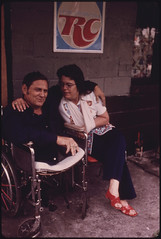
Flickr: Jack and Della Mae Smith in Front of the Beer Joint He Operates in Rhodell, West Virginia, near Beckley 06/1974


Jack and Della Mae Smith in Front of the Beer Joint He Operates in Rhodell, West Virginia, near Beckley 06/1974
Originally uploaded by The U.S. National Archives

The Flickr Commons project continues to include images from the history of disability. In this 1974 color photo from the US National Archives, we see Jack Smith with his wife, seated under an "RC" sign. Jack is in a wheelchair. The couple have their arms across each other's shoulders, and Jack seems to be smiling at something Della Mae is saying.

The US National Archives Flickr stream includes other photos of Jack Smith from 1974: alone, holding the family dog, with one of his young daughters, with three of his daughters, with two of his brothers, heading down the street, and working on a union poster. All the photos were taken by photojournalist Jack Corn as part of the Environmental Protection Agency's Documerica project.

Jack Smith was a new coalminer in West Virginia when he lost both legs in a mine cave-in, years before these photos taken. He remained active in union work, and ran a "beer joint" with Della Mae in Rhodell, West Virginia. In the notes attached to one of the photos in the series, it says "During the Strike for Black Lung Benefits His Wife Wheeled Him in Front of a Train to Stop It."


Sunday, September 13, 2009

September 13: Phineas Gage's Accident (1848)

[Image description: a daguerreotype photograph of Phineas Gage, framed in gold; he's holding the iron rod that injured his skull. Gage is facing the camera, is dressed in a suit and cleanshaven; he has combed, dark hair and one closed eyelid.]

On this date in 1848, a 25-year-old railroad worker named Phineas Gage was injured in an accident on the job, outside Cavendish, Vermont. An iron rod that was about three-and-a-half feet long and a little more than thirteen pounds in weight was driven through Gage's head in an explosion. It went up through his cheek and out the top of his head. Gage survived both the accident and the treatment he received for his injuries. He died almost twelve years later, age 36, in California.

Those are the bare facts. But the legends surrounding Phineas Gage are more elaborate. Maybe you ran into the name in a freshman psych class, or on a television hospital drama. Maybe it was accompanied by the explanation that the survival of Gage encouraged the development of neurosurgery as a discipline, or maybe you heard that his demeanor changed so dramatically after the accident that it revolutionized thinking about the organic basis of personality.

Well, not so much. Turns out, nobody really knows much for certain about Gage's personality changes--the main source on that element of the story was compiled years after his death, mostly from his mother's decades-old recollections. And neurosurgery and theories about the organic basis of personality developed from many sources; the Gage story may have made a good illustration of the latter, but it wasn't really a spur to such theorizing. The fabulations around Gage were noticed almost as soon as they began. Scottish neurologist David Ferrier commented in 1877:
In investigating reports on diseases and injuries of the brain, I am constantly amazed at the inexactitude and distortion to which they are subject by men who have some pet theory to support. The facts suffer so frightfully.
Gage recovered impressively from his brain and skull injuries--though he lost the use of an eye, and had some significant scars, of course. His skull's shape was changed, so much so that a plaster cast was made of his head for exhibition purposes. Gage also made some public appearances, so great was the curiosity surrounding his story. In time, the sensation died off, and he went to work as a coach driver in Chile for a period of years. Ill-health sent him to San Francisco to live with his mother and sister; he died there in May of 1860, age 36, after several months of experiencing severe convulsions. Six years later, his mother gave permission for Gage's skull to be displayed with the infamous rod in an anatomical museum at Harvard, where they remain to be seen today. (The site of the accident in Vermont is also marked with a monument describing the event.)

The image above, a daguerreotype of Gage taken after the accident, was only identified as Gage this year (2009). Until recently, the private holders of the image (Jack and Beverly Wilgus) believed it was an unnamed whaler, holding a harpoon. They said as much when they posted the image to Flickr. A Flickr commenter told them that the iron bar was no harpoon; another suggested this might be a photo of Phineas Gage, and that turned out to be the case. (Yeah for Flickr commenters!)

Monday, January 05, 2009

January 6: Percivall Pott (1714-1788)

Text not available
Observations on the Nature and Consequences of Those Injuries to which the Head is Liable from External Violence To which are Added, Some Few General Remarks on Fractures and Dislocation By Percivall Pott

Doctors sometimes write about or from their own personal medical experiences, because, well, doctors have bodies too. Think Oliver Sacks' A Leg to Stand On, or Claudia Osborn's Over My Head, or Jill Bolte Taylor's recent A Stroke of Insight (she's a brain scientist, not a physician, but the idea is similar).

An early member of the club is Percivall Pott, an English surgeon. At age 42, he fell off a horse and sustained a serious broken leg. The standard of care for his kind of injury in the 1750s was amputation--which wasn't much care at all, because the surgery itself was quite likely to bring death by sepsis. Instead, his friend and mentor Edward Nourse ordered his wound cleaned, reduced, dressed, and splinted. Pott wrote during his convalescence. Upon recovery, he wrote up the successful treatment in Some Few Remarks Upon Fractures and Dislocations (1768). The book became a popular reference for surgeons in much of western Europe. "It is possible that but for his accident Pott would not have turned to authorship, and surgical literature would have been the poorer," commented Brown and Thornton (see below). Because bonesetting in Pott's day was considered something requiring only minimal skill, he cautions readers from the outset to beware bonesetting quacks, in terms not too far off from today's advice:
The desire of health and ease, like that of money, seems to put all understandings and all men upon a level; the avaritious are duped by every bubble, the lame and the unhealthy by every quack. Each party resigns his understanding, swallows greedily, and for a time believes implicitly the most groundless, ill-founded, and delusory promises, and nothing but loss and disappointment ever produces conviction. (Pott, 2)
Pott is also credited with being the first scientist to link cancer to environmental causes, when he found an association between exposure to soot and a specific cancer of the groin common to chimney sweeps. (The first signs of the cancer were called "soot-wart" by sweeps.) One of the earliest occupational safety laws in the UK was written in part as a response to Pott's discovery. Pott also wrote on spinal arthritis, head injuries, and hernias.

See also:
John R. Brown and John L. Thornton, "Percival Pott and the Chimney Sweepers' Cancer of the Scrotum," British Journal of Industrial Medicine 14(1)(January 1957): 68-70. Online here.

Monday, July 02, 2007

Assisted suicide in Wharton's The Fruit of the Tree (1907)

I just finished reading Edith Wharton's The Fruit of the Tree, a 1907 novel about marriage and idealism and stepfamilies and workplace safety and assisted suicide. Yes, one hundred years ago, the central ethical and practical conflicts of a novel swirl around questions of pain management, prognosis, and patient consent.

The theme starts in the first conversation between main characters John Amherst, a mill operative, and Justine Brent, a nurse, about the condition of a mill hand about to lose his forearm after an accident on the job:
"And what will the company do for them when the wife is a hopeless invalid, and the husband a cripple?"

Amherst again uttered the dry laugh with which he had met her suggestion of an emergency hospital. "I know what I should do if I could get anywhere near Dillon--give him an overdose of morphine, and let the widow collect his life-insurance, and make a fresh start.[...] In your work, don't you ever feel tempted to set a poor devil free?"

She mused. "One might...but perhaps the professional instinct to save would always come first."

"To save what? When all the good of life is gone?"

"I daresay," she sighed, "poor Dillon would do it himself if he could--when he realizes that all the good is gone."

"Yes, but he can't do it himself; and it's the irony of such cases that his employers, after ruining his life, will do all they can to patch up the ruins."
Later in the novel, in a typical Wharton twist, Amherst's wife Bessy is paralyzed from the neck down in a riding accident, and Justine is her nurse. She consults a clergyman, a doctor, and a lawyer, all men, who all assure her that hastening Bessy's likely end would be wrong. Bessy's pleas, and the memory of that earlier conversation with Amherst, still convince Justine to administer the overdose of morphine. She never denies the act, but she doesn't tell Amherst or Bessy's family either. When they learn of it, she is effectively banished from the family. Far from approving assisted suicide for his own kind, Amherst is horrified by the fact--it's right for a mill hand who loses his arm, in his calculation, but not for a wealthy woman who becomes paralyzed.

There are a few elements of the story that are of their era: Bessy's pain cannot be managed effectively, and she has one of those plot-friendly injuries that are both immobilizing and intensely painful, and still allow her to speak. There are no surgical or therapeutic options for her, either, although her scientific young doctor is fascinated by the "case," and hopes that he can keep her alive for a long time, at all costs, just to prove his theories and prowess (the doctor is abusing morphine himself). There's no real medical "system" at work: the doctors and nurses who appear are all hired and paid by the patient's family directly, and visit the patient at home--no hospital, no insurance, no ethics committee in sight.

And most critically, Bessy's personal autonomy is disregarded, because she is a woman. She has a living father and husband, and their word carries more authority than her own in serious matters; her wealth also complicates the situation. Justine feels justified in obeying Bessy's desperate pleas, in part, by a New Woman's sense of female solidarity. As Donna Campbell writes in the introductory notes to the 2000 edition from Northeastern University Press,
Defined as a rich woman whom Amherst has never been able to wean from the position of social parasite, Bessy is already, according to the laws of class and consumption, a useless body. Thus Bessy's accident intensifies but does not fundamentally transform her status, a status that according to the laws of class validates the right of the rich to be useless....Justine exposes the unwritten explosive principle that science or its representatives may kill the useless body of the poor but not of the rich. [xxvi-xxvii]
The central section of the book, from the time of Bessy's accident to the moment of her death, is packed with discussions about bodies, and quality of life, and modern medical advances, and the responsibility of nurses and doctors. The plot was apparently inspired by Wharton's upset after a woman friend was paralyzed and died months after an accident, in pain similar to what she assigned to Bessy. This real-life counterpart is discussed at length in the big brand-new (2007) Wharton biography by Hermione Lee.

The last section of the book is aftermath--this isn't an assisted suicide tale where the death is the end of the story, a solution for all concerned. Instead, it's a moment that continues to haunt and twist and nearly destroy the survivors. It's not hard to see where Wharton's sympathies lie (Justine Brent is, after all, an almost too-perfect heroine), but she gives the subject a complex, unsettling treatment anyway. For that, the novel should be read and discussed. Even a hundred years later.
Tuesday, February 27, 2007

February 27: Alice Hamilton (1869-1970)

Living in a working-class quarter, coming in contact with laborers and their wives, I could not fail to hear tales of the dangers that workingmen faced, of cases of carbon-monoxide gassing in the great steel mills, of painters disabled by lead palsy, of pneumonia and rheumatism among the men in the stockyards. Illinois then had no legislation providing compensation for accident or disease caused by occupation. (There is something strange in speaking of 'accident and sickness compensation.' What could 'compensate' anyone for an amputated leg or a paralyzed arm, or even an attack of lead colic, to say nothing of the loss of a husband or son?)
Ever met someone with phossy jaw? How about painter's colic? Probably not, if you live in the West; the early 20th century saw a successful movement in the US and Europe to improve workplace safety and hold employers accountable for hazardous conditions in the manufacturing process. One of the scientists at the forefront of research on industrial medicine in the US was Alice Hamilton, born on this date in 1869 (image at right is her portrait on a 55-cent US postage stamp), in Indiana. She was a longtime resident of Jane Addams' Hull House, the first woman on the faculty at Harvard Medical School, an active member of the Woman's Peace Party, and she lived long enough to denounce McCarthyism and US involvement in Vietnam. Read here from her memoir how she became interested in industrial medicine, and the resistance she faced in trying to study workplace hazards (the quote above is an excerpt).

Monday, September 12, 2005

Florence Kelley, 1859-1932

Today is the birthday of American reformer Florence Kelley (1859-1932). Besides being active in the suffrage, civil rights, and peace movements, and translating Engels, and living at Hull House, Kelley was Illinois' first chief factory inspector, appointed by the governor in 1893. In that role, she wrote reports of factory conditions, passionate reports that advocated child labor, minimum wage, and maximum day laws. The first report (1894) includes a section titled "Injurious Employments," where she describes disabled children exploited as workers, and child workers disabled by unsafe factory conditions (deafened by the noise, lungs and eyes damaged by the poor air quality, bones developed with curvatures from awkward positions, fingers and limbs lost to cutting machinery, hernias from heavy lifting, etc.). "The mutilation of children will continue to be a matter of daily occurrence," warns Kelley, without protective legislation.