Hey! A new post at DSTU.
As I've mentioned, in recent years I've been putting some energy into Wikipedia. I like writing new entries there, because it feels like that's going to reach a much bigger audience than a journal article or a paywalled reference. And, as part of WikiProject Disability, some of my entries are about disability topics (of course). Since last BADD in May, I've started new entries for baseball coach Mary Dobkin, businessman Dwight D. Guilfoil Jr., South African activist Maria Rantho, wheelchair manufacturers Everest & Jennings, blind biochemist Dilworth Wayne Woolley, playground builders Shane's Inspiration, and blind singer/lawyer Christine la Barraque. I also built out an existing stub entry on educator Elizabeth E. Farrell, during the "Justin Dart Jr. Virtual Edit-a-thon 2015" in August.
None of these are exhaustive entries; they're a good solid start, I think, but if anyone reading this blogpost has more to add, with reliable sources to back up any new information, please jump in! Christine la Barraque has me especially curious right now (because I just wrote about her on Friday). She seems, pretty definitely, to have been the first blind woman to pass the bar in California; but was she the first in any state (as some sources suggest)? Was she the first blind woman to graduate from the University of California, in 1896 (when she was about 18 years old, by the way)? Anytime "the first" is on the table, there are questions and complications: who counts as blind? or graduating? or a woman? La Barraque was said to have been born in France, but exactly where is sketchy and mentions contradict each other. If she was, her parents came to America with a blind child, through immigration screens intended to prevent that scenario. So I would love to know more about them, too. (I think they lived in Tres Pinos or Paicines, California--when she was living in Boston at the time of the San Francisco earthquake, she sent a telegram to the governor of California asking after "my people in Tres Pinos.")
La Barraque wasn't an obscure singer or advocate; she performed for Helen Keller and Mark Twain, she was a founder and president of the San Francisco Workers for the Blind, she testified before the Massachusetts Legislature, she toured blind schools in Italy, she performed all over the US and apparently also in Canada. I've seen mentions of her working with disabled veterans after both World Wars, but not enough to include in the entry (yet).
Sunday, November 15, 2015


Friday, May 01, 2015
BADD 2015: Wikipedia Against Disablism, Part 2
Ahem. Hello? Hello?
Okay, I'm here for BADD 2015, because how could I break our ten-year streak of participation? I couldn't. I'm not so much of a blogger these days, but I'm willing to add my bit to the big event. For our past nine appearances in the series:
2014, 2013, 2012, 2011, 2010, 2009, 2008, 2007, 2006. (For the record, the 2007 and 2008 entries are two of my favorite blog posts I've ever written, on any blog, or any topic. BADD has been good for me.)
Last year I wrote about why Wikipedia needs more and better content on disability topics, and how anyone can help; and how that fights disablism, by shifting language, removing cliches, decreasing melodrama, respecting personhood, perhaps in small ways, but for a big diverse audience that will never see your blog or your journal article. I'm still pretty involved there, and in the past year I've found more ways to discover stories to improve Wikipedia's disability content; so I'm still preaching that same sermon today.
But first:
That headline didn't actually have anything to do with disability or discrimination, but I was still startled to see the word "Ableism" appear in a newspaper from over a century ago! I found this because I acquired a Newspapers.com subscription through The Wikipedia Library, a project that matches experienced Wikipedia editors with scholarly resources that aren't always available for off-campus folks. So far it's been extremely useful, and hardly a day passes without finding something fascinating. Like the tidbit above.
One of the ways I'm using searchable old newspapers like this is to find the disability stories that are hiding, that are lost, that we forgot, that we need to remember. Not all of them made the big national papers, but they survive in local dailies, and sometimes there's plenty to meet Wikipedia's criteria for notability and reliable sources, and start a new entry. Maybe everyone knows about Helen Keller, or thinks they do, enough to put her on US currency (again). But there are so many others worth learning about! Some American biographical examples, from recent wanderings on Wikipedia or in old US newspapers:
1. Eliza Suggs (1876-1908): "Carried in arms or wheeled about in a carriage, her frail hands and well developed head have accomplished wonders, obtaining a fair education, which makes her a valuable assistant, sometimes as secretary of religious organizations and work. In former years she assisted her father, more or less, in evangelistic work, and she has presided in public meetings with marked dignity and ability." Suggs was born in Illinois, to parents who met while they were enslaved on a Mississippi plantation; she had osteogenesis imperfecta (OI), and was a temperance activist alongside her preacher father, and later on her own. I didn't write this entry but I'm glad somebody did. Here's her memoir online, along with a photo of Miss Suggs (above, right).
2. Anita Lee Blair (1916-2010) was the first blind woman to serve in any US state legislature. I wrote about her on DSTU a few years ago, and finally got her Wikipedia entry started earlier this year. I found a campaign ad of hers from 1952 in a Texas newspaper recently, too, featuring her guide dog Fawn, and text proclaiming her achievements and her independence.
3. Elizabeth Layton (1909-1993) was an artist based in Kansas who found her art late in life, in a drawing class she took at age 68, hoping it would help with her lifelong struggles with depression, and with more acute grief following the death of her son. It did help, and it also brought her national acclaim: in 1992 she was the focus of a show at the Smithsonian's National Museum of American Art. I started her Wikipedia entry last week. At left, a 1981 drawing by Elizabeth Layton, titled "Fear." (Were you expecting sentimental art from an old lady? Her drawings were edgy, even controversial.)
4. Dwight D. Guilfoil Jr. (1926-1989) was a businessman and a disabled veteran, who advocated for hiring disabled workers, and used his own company to demonstrate the possibilities. Guilfoil doesn't have a Wikipedia entry yet, but I think he'd be a great candidate for one. For now, check out an essay he wrote titled "Let's Stop 'Handicapping' Americans," which appeared in syndication, in newspapers across the US, in 1960.
UPDATE (February 2016): Dwight D. Guilfoil Jr. has a wikipedia entry now.
5. Mary Dobkin (1902-1987) was a immigrant child in Baltimore when she lost both feet to frostbite as a little girl. This early experience, and a lifelong love of baseball, made her a tireless advocate for poor kids in her adopted city; she coached kids' teams, integrated during the Jim Crow era, and took particular interest in providing sports opportunities for disabled kids. There was a television movie made about her in 1979, but until today, no Wikipedia entry. So I'll get right on that.
By the end of today, California time, there will be a new Wikipedia entry on Mary Dobkin, in honor of BADD 2015. (I'll light up her name as a link when the entry is up.) Anyone want to join in? Plenty of other stories to tell, and every well-told story helps.
Okay, I'm here for BADD 2015, because how could I break our ten-year streak of participation? I couldn't. I'm not so much of a blogger these days, but I'm willing to add my bit to the big event. For our past nine appearances in the series:
2014, 2013, 2012, 2011, 2010, 2009, 2008, 2007, 2006. (For the record, the 2007 and 2008 entries are two of my favorite blog posts I've ever written, on any blog, or any topic. BADD has been good for me.)
Last year I wrote about why Wikipedia needs more and better content on disability topics, and how anyone can help; and how that fights disablism, by shifting language, removing cliches, decreasing melodrama, respecting personhood, perhaps in small ways, but for a big diverse audience that will never see your blog or your journal article. I'm still pretty involved there, and in the past year I've found more ways to discover stories to improve Wikipedia's disability content; so I'm still preaching that same sermon today.
But first:
 |
| Headline from a 1910 Aberdeen Herald newspaper, from Aberdeen, Washington, reads "Ableism the Issue; All Others Sunk into Insignificance in this County; All kinds of Diversions are Attempted by the Abel Press, but are not Successful. What is Abel Spending So Much Money For?" From Newspapers.com |
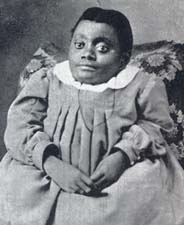 |
| Eliza Suggs (1876-1908), temperance activist |
One of the ways I'm using searchable old newspapers like this is to find the disability stories that are hiding, that are lost, that we forgot, that we need to remember. Not all of them made the big national papers, but they survive in local dailies, and sometimes there's plenty to meet Wikipedia's criteria for notability and reliable sources, and start a new entry. Maybe everyone knows about Helen Keller, or thinks they do, enough to put her on US currency (again). But there are so many others worth learning about! Some American biographical examples, from recent wanderings on Wikipedia or in old US newspapers:
1. Eliza Suggs (1876-1908): "Carried in arms or wheeled about in a carriage, her frail hands and well developed head have accomplished wonders, obtaining a fair education, which makes her a valuable assistant, sometimes as secretary of religious organizations and work. In former years she assisted her father, more or less, in evangelistic work, and she has presided in public meetings with marked dignity and ability." Suggs was born in Illinois, to parents who met while they were enslaved on a Mississippi plantation; she had osteogenesis imperfecta (OI), and was a temperance activist alongside her preacher father, and later on her own. I didn't write this entry but I'm glad somebody did. Here's her memoir online, along with a photo of Miss Suggs (above, right).
2. Anita Lee Blair (1916-2010) was the first blind woman to serve in any US state legislature. I wrote about her on DSTU a few years ago, and finally got her Wikipedia entry started earlier this year. I found a campaign ad of hers from 1952 in a Texas newspaper recently, too, featuring her guide dog Fawn, and text proclaiming her achievements and her independence.
 | ||
| "Fear" (1981) by Elizabeth Layton; a drawing of an older woman peeking out from a closet with a fearful expression |
3. Elizabeth Layton (1909-1993) was an artist based in Kansas who found her art late in life, in a drawing class she took at age 68, hoping it would help with her lifelong struggles with depression, and with more acute grief following the death of her son. It did help, and it also brought her national acclaim: in 1992 she was the focus of a show at the Smithsonian's National Museum of American Art. I started her Wikipedia entry last week. At left, a 1981 drawing by Elizabeth Layton, titled "Fear." (Were you expecting sentimental art from an old lady? Her drawings were edgy, even controversial.)
4. Dwight D. Guilfoil Jr. (1926-1989) was a businessman and a disabled veteran, who advocated for hiring disabled workers, and used his own company to demonstrate the possibilities. Guilfoil doesn't have a Wikipedia entry yet, but I think he'd be a great candidate for one. For now, check out an essay he wrote titled "Let's Stop 'Handicapping' Americans," which appeared in syndication, in newspapers across the US, in 1960.
UPDATE (February 2016): Dwight D. Guilfoil Jr. has a wikipedia entry now.
5. Mary Dobkin (1902-1987) was a immigrant child in Baltimore when she lost both feet to frostbite as a little girl. This early experience, and a lifelong love of baseball, made her a tireless advocate for poor kids in her adopted city; she coached kids' teams, integrated during the Jim Crow era, and took particular interest in providing sports opportunities for disabled kids. There was a television movie made about her in 1979, but until today, no Wikipedia entry. So I'll get right on that.
By the end of today, California time, there will be a new Wikipedia entry on Mary Dobkin, in honor of BADD 2015. (I'll light up her name as a link when the entry is up.) Anyone want to join in? Plenty of other stories to tell, and every well-told story helps.
Sunday, April 19, 2015
Disability at AAG [Assn. of American Geographers] April 21 - 25, 2015
This is the AAG Disability Specialty Group featured session, right before the business meeting at the AAG Annual Meeting in Chicago, Illinois (April 21-25, 2015). Mike
1177 Questioning geography’s ‘healthy subject’ I: Geography and Mental Health
(Sponsored by Disability Specialty Group, Cultural Geography Specialty Group, Geographic Perspectives on Women Specialty Group )
Friday, April 24, 10:00 a.m. - 11:40 p.m.
Room: Grand E/F, Hyatt, East Tower, Gold Level (Panel Session)
Disability Specialty Group annual business meeting at the Annual Meeting of the Assoc. of American Geographers will be held Friday, April 24 in Hyatt East, room Columbus EF. Meeting starts at 11:50am and runs to 1:10pm
Searched by Keyword: disabilit
Tuesday
The Inclusion of People with Disabilities in Emergency
Planning. 4/21/2015 at 14:40 PM
'Undue Burden': Disabled People, Immigration and the Politics of (Im)mobility 4/21/2015 at 14:40 PM
'Undue Burden': Disabled People, Immigration and the Politics of (Im)mobility 4/21/2015 at 14:40 PM
Wednesday
Plain Language Mapping: Rethinking the Participatory Geoweb
to Include Users with Intellectual Disabilities, 4/22/2015 at 8:00 AM
The Double Condition: Intersections of Internal Displacement
and Physical Disability in Colombian Urban Centers 4/22/2015
at 10:00 AM
The Use of VGI in Enhancing Pedestrian Accessibility and the Quality Assurance of Location-Based Data 4/22/2015 at 15:20 PM
The Use of VGI in Enhancing Pedestrian Accessibility and the Quality Assurance of Location-Based Data 4/22/2015 at 15:20 PM
Thursday
Disability, Mobility and ICT - Empty Promises or Ways to
Inclusive Solutions? 4/23/2015 at 13:20 PM
Contours of Disability in America 4/23/2015 at 13:20 PM
Contours of Disability in America 4/23/2015 at 13:20 PM
Friday
Disability in America: Rural-Urban Differences in Spatial and Mobility Patterns 4/24/2015 at 13:20 PM
Learning to live again: Multiple presents and the becoming of disability Saturday, 4/25/2015 at 8:00 AM
Disability in America: Rural-Urban Differences in Spatial and Mobility Patterns 4/24/2015 at 13:20 PM
Learning to live again: Multiple presents and the becoming of disability Saturday, 4/25/2015 at 8:00 AM
Search by Keyword: blind
Friday
Tactile Earth: Teaching and Accommodating Blind
Students in Introduction to Physical Geography 4/24/2015 at 8:00 AM
Search by Keyword: deaf
Friday
Accessing the spaces of justice in Ireland; critical
perspectives from Deaf victims of crime 4/24/2015 at 13:20 PM
Lost Spaces - where do deaf people go to be deaf in the UK? 4/24/2015
at 13:20 PM
Mobilities and Geographies of Deaf Youth in Turkey, 4/24/2015 at 13:20 PM
Productions of Deaf Spaces within a Finland-Swedish context - a minority in diaspora 4/24/2015 at 13:20 PM
Mobilities and Geographies of Deaf Youth in Turkey, 4/24/2015 at 13:20 PM
Productions of Deaf Spaces within a Finland-Swedish context - a minority in diaspora 4/24/2015 at 13:20 PM
Upstairs and downstairs: a Deaf church's tale 4/24/2015
at 17:20 PM
A Taxonomy of SLP Spaces: a scalar framework. 4/24/2015 at 17:20 PM
'Doing Deaf': Mapping the performative spaces of Brighton and Hove city 4/24/2015 at 17:20 PM
The Agency of Deaf space; Anglicanism, philanthropy and the London Deaf church in the 19th century. 4/24/2015 at 17:20 PM
A Taxonomy of SLP Spaces: a scalar framework. 4/24/2015 at 17:20 PM
'Doing Deaf': Mapping the performative spaces of Brighton and Hove city 4/24/2015 at 17:20 PM
The Agency of Deaf space; Anglicanism, philanthropy and the London Deaf church in the 19th century. 4/24/2015 at 17:20 PM
Searched by Keyword: mental heal
Tuesday
Places sit in bodies: Capitalist food regimes at the
cellular level 4/21/2015 at 8:00 AM
Does Socially-Mixed Housing Redevelopment "Work"? The Case of Toronto's Regent Park 4/21/2015 at 14:40 PM
Does Socially-Mixed Housing Redevelopment "Work"? The Case of Toronto's Regent Park 4/21/2015 at 14:40 PM
The Asylum is on These Streets: Managing Mental
Illness in the Carceral Community 4/21/2015 at 16:40 PM
Wednesday
Geographic Accessibility and Barriers to Addiction, Mental
Health, and HIV/AIDS Health Care Services for Opioid Dependent Clients 4/22/2015
at 13:20 PM
What Best Predicts Addiction Treatment Completion: The
Influence of Client Factors and Rural, Suburban, and Urban Treatment Facility
Location 4/22/2015 at 13:20
Thursday
PM.
Transforming the environmental health paradigm through
climate justice work: popular education and place-making in the Scottish
Central Belt, 4/23/2015 at 10:00 AM
Mobilities of Madness: Interurban spatial movement among a
cohort of homeless individuals with co-occurring mental health issues 4/23/2015
at 15:20 PM.
Saturday
Crowd mapping mental health promotion through the Thought Spot project 4/25/2015 at 8:00 AM
Housing First houses but does not end poverty: Stories from Winnipeg 4/25/2015 at 8:00 AM
A working recovery? Psychiatric consumers, paid employment and 'Other' mental health geographies 4/25/2015 at 8:00 AM
Crowd mapping mental health promotion through the Thought Spot project 4/25/2015 at 8:00 AM
Housing First houses but does not end poverty: Stories from Winnipeg 4/25/2015 at 8:00 AM
A working recovery? Psychiatric consumers, paid employment and 'Other' mental health geographies 4/25/2015 at 8:00 AM
Search by Keyword: accessibility
Tuesday
Measuring Spatial Disparities in Disadvantaged
Populations: A Literature Review of Individual Space-Time Accessibility 4/21/2015 at 8:00 AM
Wednesday
Geographic Accessibility and Barriers to Addiction,
Mental Health, and HIV/AIDS Health Care Services for Opioid Dependent Clients 4/22/2015 at 13:20 PM
Geocrowdsourcing and Accessibility for
Mobility-impaired Individuals at Dynamic Environments 4/22/2015 at 15:20 PM
Thursday
Geographies of Health Care in South Korea: Measuring
Spatial Accessibility to Public Health Care Facilities in the Seoul
Metropolitan Region
4/23/2015 at 8:00 AM
Patterns in Non-visual Map Reading: Stylus-based
Interaction with an Auditory GIS 4/23/2015 at 13:20 PM
Friday
Parks for all: Information on accessibility and
associated experiences. 4/24/2015 at 17:20 PM
Exploring Transportation Accessibility to Health Care
Among Vermont's Rural Seniors not
scheduled yet
Search by Keyword: chronic disease
Wednesday
The development and validation of national liveability
indicators: linking geography, urban policy, chronic disease risk factors and
health outcomes in Australia 4/22/2015
at 17:20 PM
Search by Keyword: elderly, dementia, Alzheimer
Wednesday
Visual and Material Home Making in Transnational Alzheimer's
Care 4/22/2015
at 10:00 AM
The Geographies of Mortality Attributed to Alzheimer's
Disease in the contiguous United States from 2000 to 2008 4/22/2015 at 10:00 AM
Older People's Perceptions of Elderly Dining Services
in China 4/22/2015 at 13:20 PM
Thursday
Intra-person and inter-person interactions in daily
activity participation in elderly co-residence households 4/23/2015 at 10:00 AM
Qualitative GIS for dementia friendly environments:
Illuminating spatial perspectives 4/23/2015 at 13:20 PM.
Should I stay or should I go? Housing preferences upon
retirement in Germany 4/23/2015 at 15:20 PM
Identifying local blind spots of medical care service
for the impoverished elderly by mapping a local accessibility measure 4/23/2015 at 17:20 PM
Friday
The association between preventable hospitalizations
and geographic access to health care for elderly in South Texas 4/24/2015 at 17:20 PM
Saturday
Constraining care: Caring for persons with dementia in
rural Ontario, Canada 4/25/2015 at 10:00 AM
Wednesday, August 20, 2014
Enrico Toti (1882-1916)
 |
| Statue of Enrico Toti in Rome; much-larger-than-life muscular male nude, holding a crutch, with his left leg ending mid-thigh. In a park setting, with blue skies. Base is inscribed with his name and other text in Italian. |
With all the WWI centenary coverage, we were moved to come across this statue at the Villa Borghese gardens, on a recent family vacation in Rome. Enrico Toti (1882-1916) was a railway worker from Rome; his leg was lost in a workplace accident in 1906. After that, he became a distance cyclist, riding from Rome to Lapland, and down to Egypt, to great acclaim. At the onset of WWI, he was considered unfit for military service, but he volunteered as a bicycle courier, and became an unofficial member of the 3rd Bersaglieri Bicycle Battalion. He died at the Sixth Battle of Isonzo, and is one of the very few civilians awarded Italy's medal for military valor.
Wednesday, April 30, 2014
BADD 2014: Wikipedia Against Disablism
 | |
| Manke Nelis (1919-1983), a Dutch singer and musician whose right leg was amputated after a motorcycle accident in the 1950s; in this image, he is an older man on a sports field, singing into a microphone, with his arms raised. His sweatshirt reads "Nelis Goes to Hollywood." Image from Wikimedia Commons (of course). |
(Blowing dust from the mike)
Tap tap tap.... hello? testing... hello?
Yeah, it's been a long time since we posted any new content here on DSTU. But today is Blogging Against Disablism Day, and I have it on good authority (from Goldfish directly) that we're the only blog that participated in all eight previous BADDs, so I'd hate to break that streak. We're here for BADD.
Our previous eight appearances: 2013, 2012, 2011, 2010, 2009, 2008, 2007, 2006. (For the record, the 2007 and 2008 entries are two of my favorite blog posts I've ever written, on any blog, or any topic. BADD has been good for me.)
If you clicked any of those links, you'll know I usually blog about disability history for BADD--about the ways we use and record history, the stories we forget, and the stories we need to remember and retell. This year, I'm on the same soapbox, but this time, no rant--instead, a challenge.
For the past couple years, I've been putting more and more time and energy into editing on Wikipedia. It's not easy, but it's interesting, and I seem to have a knack for it. I'm slowly learning how to do more and more there. I know schoolkids aren't supposed to use Wikipedia, but I hope they do anyway, because I'm consistently impressed with the way new entries are combed for typos, outlandish declarations, and unsupported claims of notability. Writing on Wikipedia makes me think about the details.
I mostly create biographical entries for women, artists and scientists and museum folk not previously represented with full entries. In addition to starting new entries, I make many small edits on existing entries--and some of those small edits involve shifts in language, removing cliches, decreasing melodrama, respecting personhood. In other words, I find ways to use Wikipedia to fight disablism when I spot it. Might seem extremely minor, but these entries are consulted by many thousands more readers than a journal article or a blog post will ever draw. And the beauty of crowdsourcing is in the cumulative effect of many little contributions and improvements.
So now the challenge: join me. Or maybe join WikiProject Disability, which is the gathering of Wikipedians interested in disability topics. Editing from a base of support and coordination like a WikiProject helps in learning the ropes. Or try an edit-athon--there are several going on in any given month--you can participate in person or virtually. Edit-athons are supportive events, and tend to bring more attention to their products. Can you contribute images or sound clips to Wikimedia, or verified quotes to Wikiquote, for use in Wikipedia entries? Maybe you can translate an entry, or add a Wikipedia assignment to your course syllabus.
There's plenty of work to do out there--and Wikipedia is one pretty nifty place to do some of it.
Thursday, December 05, 2013
Nelson Mandela on "the long walk to equality"
"We cannot claim to have reached anywhere near to where a society should be in
terms of practical equality of the disabled. We continue to try. We
realise that legislation and regulations are not sufficient or the end
of the long walk to equality and non-discrimination. Education, raising
of awareness, conscientisation, eradication of stigmatisation: these are
key elements in achieving non-discrimination against the disabled in
practice and in their everyday lives."
--Nelson Mandela (1918-2013), in a 2004 message
Sunday, September 15, 2013
RIP: Anita Blair (1916-2010) and Betty G. Miller (1934-2012)
Two obituaries came to my attention this morning. Both women died more than a year ago, but I'm just seeing these now. If I write about them here, I won't forget to follow up with getting Wikipedia entries going about them, when the time allows.
 I first mentioned Anita Lee Blair (pictured at left, a white woman dressed in a dark suit, in a portrait with her guide dog Fawn) at this blog a few years ago, when David Paterson had become Governor of New York, and the topic of blind elected officials was in the news. Anita Blair was born in 1916, and became blind after head injuries sustained in a car accident, not long after graduating from high school (no seatbelts or safety glass in the 1930s). She graduated from the Texas College of Mines and Metallurgy; later she earned a master's degree as well. She was the first person in El Paso to receive a guide dog, a German shepherd named Fawn; she even made a short film about Fawn, to use on her lecture tour. Fawn and Anita made headlines in 1946, when they escaped a deadly hotel fire in Chicago. As far as anyone can tell, she was the first blind woman ever elected to any state legislature--she served one term in the Texas House of Representatives, 1953-55. (Here's a Time Magazine article mentioning that she won the Democratic nomination for that race.) She was also the only woman appointed to Harry Truman's Presidential Safety Committee, the first person to bring a service dog onto the floor of the US Senate, and later was a familiar presence in El Paso, vocal on talk radio and at city council meetings. Anita Lee Blair died in 2010, just a couple weeks before her 94th birthday, survived by her slightly younger sister Jean. Upon her passing, the Texas House of Representatives passed a resolution in tribute to their former member. There's a video of Blair talking about her life on youtube (not captioned), and her El Paso Times obituary included a photo gallery from news files.

Betty G. Miller's obituary turned up in this month's Penn State alumni magazine. (Miller is pictured at right, a white woman wearing a hat and glasses, with a big smile.) She was a deaf child of deaf parents, and learned ASL as a child at home, but was sent to oral education programs also, an experience that became a theme in her works. Betty Miller was an artist, an art educator (she had an EdD from Penn State, and taught at Gallaudet), an author, and by her own account the first deaf person to receive certification as an addiction counselor. In 1972 she had her first one-woman show, "The Silent World," at Gallaudet. Further shows followed over the next several decades, and a large-scale neon installation by Miller is in the lobby of the Student Activities Center at the Eastern North Carolina School for the Deaf. She was survived by her partner, artist Nancy Creighton. Some of Miller's works can be seen in this Wordgathering article by Creighton and at this Pinterest board.
Apparently, this is post #1000 at DSTU, according to Blogger (I suspect that count includes some drafts that didn't ever get posted, for various reasons). Happy 1000 to our readers, then!
Betty G. Miller's obituary turned up in this month's Penn State alumni magazine. (Miller is pictured at right, a white woman wearing a hat and glasses, with a big smile.) She was a deaf child of deaf parents, and learned ASL as a child at home, but was sent to oral education programs also, an experience that became a theme in her works. Betty Miller was an artist, an art educator (she had an EdD from Penn State, and taught at Gallaudet), an author, and by her own account the first deaf person to receive certification as an addiction counselor. In 1972 she had her first one-woman show, "The Silent World," at Gallaudet. Further shows followed over the next several decades, and a large-scale neon installation by Miller is in the lobby of the Student Activities Center at the Eastern North Carolina School for the Deaf. She was survived by her partner, artist Nancy Creighton. Some of Miller's works can be seen in this Wordgathering article by Creighton and at this Pinterest board.
Apparently, this is post #1000 at DSTU, according to Blogger (I suspect that count includes some drafts that didn't ever get posted, for various reasons). Happy 1000 to our readers, then!
Subscribe to:
Posts (Atom)

