
I've added a new post (both in -bad- English and in fine Spanish) to Caperucita Coja's Blog about Accion Mutante.


The greatest source of inspiration is hard work. Of course, I also believe in inspiration itself, but sometimes you have to provoke it, call on it repeatedly, even though it may take a while.Born on this date in 1901, Spanish pianist and composer Joaquín Rodrigo Vidre (pictured at right, as a young man), in Sagunto, Valencia. He was blind from age three, after surviving diphtheria. Young Joaquín attended a school for blind children in Valencia, where he learned braille. He later studied music in Paris. He first achieved fame at the age of 23, when he won Spain's National Prize for composers.
--Joaquín Rodrigo
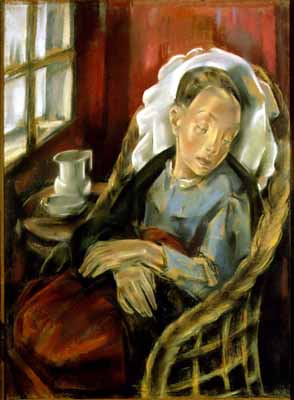 Today is the 125th anniversary of the birth of Maria Gutierrez-Cueto y Blanchard, a Spanish Cubist painter who was born this date in 1881 in Santander. Blanchard was called "jorobada," or hunchbacked, from birth. She trained as an artist in Madrid, and found some success as a painter in Paris, before her early death in 1932, from tuberculosis. Federico Garcia Lorca wrote an elegy to Blanchard. Most of the websites I found about her were in Spanish (as might be expected), but I also found this bio, in Dutch. The late painting at right, "La Convaleciente" (1930-32, found here), indicates that Blanchard's disability experience was reflected her work. Has anyone looked at Blanchard's life and work from a disability history perspective, in any language? I'd love to know.


