Showing posts with label cerebral palsy. Show all posts

Tuesday, April 30, 2013

BADD 2013: Bad History Doesn't Help

Blogging Against Disablism Day, May 1st 2013

It's that time of year again--for the eighth May in a row, it's Blogging Against Disablism Day, hosted by the ever-excellent Goldfish.  How many things last eight years online, with hundreds of quality contributions, from bloggers all over the world? This has.

We've contributed to BADD every year--sometimes with a long essay, sometimes with a calendar, sometimes with a paragraph, sometimes with images. Our previous contributions:
2006
2007
2008
2009
2010
2011
2012

This year, I'm on another cranky rant--about bad history.  Bad disability history, to be precise.  It's all too common, it doesn't help fight disablism, and in fact it often hurts the cause.

The classic example of bad disability history is the faux etymology of "handicap." Maybe you've run into the mistaken notion that "handicap" is somehow related to the phrase "cap-in-hand," a reference to a beggar's gesture, removing one's hat in humility, before asking a favor.  It's still easily found on some organizations' websites and even state agencies' sites (but I'm happy to see that there are many fewer such appearances than I saw ten years ago).  It's been common enough to be included in Wikipedia's "List of Common False Etymologies," which is worth a visit whenever one of these chestnuts comes along.  Anyway, Ron Amundson wrote the definitive debunk of this tale, and it's also clearly labeled "false" on snopes; but that doesn't keep it from being circulated (that link will take you to a 2011 textbook that tells the false etymology as fact).  If your book or website includes this nonsense, I'm going to wonder if the rest is also cut-and-pasted from a dodgy source, without any effort to fact-check.  Bad history hurts the cause.

******

Portrait of Stephen Hopkins (1707-1785, seated, holding a quill pen in his right hand
Here's a factoid that comes around every July in the US--did you know that one of the signers of the Declaration of Independence had cerebral palsy? Well, maybe--maybe a member of the Continental Congress in 1776 had a physical condition we'd call cerebral palsy today. Impossible to say, since it wasn't a diagnosis ever given in the eighteenth century.  But that person probably wasn't Stephen Hopkins (1707-1785), to whom cerebral palsy is sometimes attributed.  The attribution usually rests on two facts:
1.  Hopkins had a shaky signature on the Declaration.
2.  Hopkins is said to have acknowledged his shaky handwriting in the moment, with the statement "My hands may tremble, but my heart does not." 
A person's hand might tremble for various reasons. But let's look at more details of Hopkins' life before jumping to diagnose him with cerebral palsy.  As it turns out, we have many examples of his writing throughout life, because he was a professional surveyor, justice of the peace, town council president, Chief Justice of the Rhode Island Supreme Court-- all jobs that required handwriting.   And as a young man, Hopkins had unusually clear handwriting, according to his nineteenth-century biographer, William Eaton Foster:
"The records of the town of Scituate for these ten years [1736-1746], in his handwriting, are still in good preservation, and are of interest from their legibility and neatness. Written before the nervous difficulty of his later years..."
In mid-life, Hopkins' writing became less and less legible; eventually he hired an amanuensis, someone to do his writing for him.  His palsy was progressive, with onset well into adulthood. That could match a lot of diagnoses, but it doesn't sound anything like cerebral palsy.  Remember, starting a sentence with "many medical historians believe..." doesn't get anyone off the hook from bad history.  Which medical historians? When, where, why? Again, if your book or website includes assertions of fact that are easily contradicted by evidence, I'm going to wonder what else it says that I can't trust.  Bad history hurts the cause.

*******
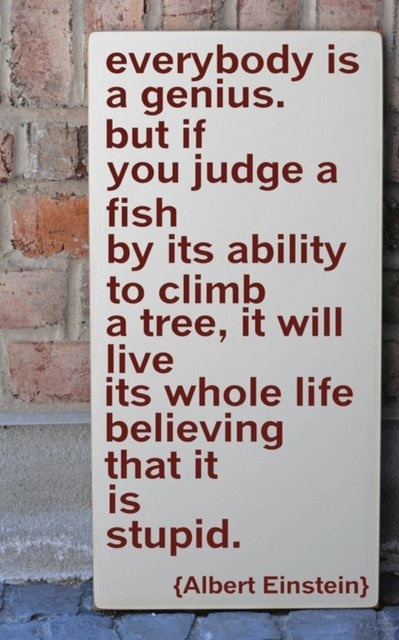

(Sign that says "Everybody is a genius. But if you judge a fish by its ability to climb a tree, it will live its whole life believing that it is stupid. (Albert Einstein)")

Finally, here's a quick one, but I'm seeing it a lot lately in disability-focused spaces.  Albert Einstein never said this quote about fish climbing trees.  Doesn't matter what cute sign or graphic you saw on pinterest, he just didn't.  The quote seems to have first appeared in a self-help book in 2004, quite a long time after Einstein's passing; wikiquote has it under unsourced or dubious/overly modern.

Misquotes are pretty easy to look up in the 21st century.  Good history checks the source, finds a title and page number, before using a quote (or making a cute sign with it).  Again, the appearance of a well-known misquote throws everything around it into question.  Bad history hurts the cause.

*******

Please be scrupulous about the disability history you use to fight disablism; a solid assertion of fact is powerful! Faux etymology, misattributed quotes, and garbled legends, not so much.  Also, those things make me really cranky.

Want to learn more? Come visit the Disability History Association website--or become a member!  Join the H-Disability listserv, now in its twelfth year. 


Friday, April 29, 2011

Giuseppe Pontiggia, "Born Twice"

I recently picked up the English translation of the Italian novel Nati due volte by the late Giuseppe Pontiggia, because it seemed like my kind of subject--the narrator is a father whose second son has cerebral palsy. It's not so much a novel as a series of vignettes, thirty-eight scenes across the son's first three decades, in the father's marriage and work lives. I have no way to judge whether the translation is a good one, but some of the observations are very sharp, unsentimental, like this description of another parent, a mother in a parent support group:
Her son's case is not serious; he has trouble walking, and physiotherapy alone will probably take care of it. She tends to observe us with careful and detached curiosity, like a first-class traveler visiting the third-class deck. She never neglects to mention the minor nature of her son's condition. When we're discussing the most difficult cases she opens her eyes wide in a kind of theatrical solidarity, but you can tell that hearing other people's stories simply offers her yet another form of reassurance. (p. 69 in my copy, at the beginning of the chapter titled "Pleasure Island")
Yep. Met her, or at least met her American sisters (and brothers). Other standout chapters for me were focused on the son's school principal, a visit with a dementia specialist, and a lot of the conversations with the son (Paolo) as a teen and young man. The title phrase, Born Twice, refers to a counselor's advice that "These children are born twice. They have to learn to get by in a world that their first birth made difficult for them. Their second birth depends on you, on what you can give them...." I remember being aware of that, when my son was first born. I had been a teacher, I knew full well that birth didn't have the last word on anyone's outcomes in life.

Friday, July 18, 2008

July 18: Hermann of Reichenau (1013-1054)

[Image description: A painting showing a brown robbed monk, Hermann, holding a crutch in one hand and a book in the other, with a harp nearby, and the words "Salve Regina," the name of his best known composition; found here]

Maybe some of the fine medievalists blogging about disability history can help with this one: I saw reference to Hermann von Reichenau's birthday today (the Catholic Encyclopedia gives the date as 18 February instead; still, five years till his 1000th!). The son of a nobleman, he didn't walk, and was hard to understand when he spoke, so the assumption is usually that he had CP or something similar. He was called "Hermann der Lahme," or "Hermannus Contractus" or Hermann the Lame, Hermann the Twisted. At age 7 Hermann entered the monastery at Reichenau. There, he became an expert on Arabic mathematics and astronomy, composed hymns and poetry, and wrote historical chronicles and treatises on music theory and math games. He seems to have introduced the astrolabe to central Europe, among his other accomplishments.

The relics on display here seem to include part of Hermann's skull? Am I seeing that right?

While I'm on the subject of cloisters, I recently read Mark Salzman's Lying Awake (Vintage 2001), a short novel about a cloistered nun in 1990s California who's diagnosed with temporal lobe epilepsy. But Sister John, a published poet, experiences her seizures as ecstatic spiritual revelations, and isn't sure she wants to lose that by having the recommended neurosurgery. The story follows her decision-making, the conversations she has with doctors and priests and her sisters in the community. It's thought-provoking, because the life of a woman religious involves vows and habits of selflessness that affect her criteria for deciding about medical treatment. (If the author's name rings a bell, Mark Salzman is married to filmmaker Jessica Yu, who won the Academy Award for her 1996 short-subject documentary Breathing Lessons--about Berkeley poet Mark O'Brien, who used an iron lung.)

Sunday, December 30, 2007

Definitely living!

smiling child[Image description: Smiling blond boy in a zip-up hoodie, sitting in a cylindrical playground structure made from red mesh.]

Jacqui at Terrible Palsy says, "You all know how much I hate the media portraying a person as suffering from cerebral palsy. So I was thinking to myself - how come they can’t say that a person is living with cerebral palsy." She follows this with some joyous recent photos of her kids--definitely living, not suffering! I'll follow suit. Here's my boy Jake, at left, not suffering at all, at our favorite park last spring (cerebral palsy isn't his primary diagnosis, but it's one of the many boxes we check on his medical forms).

Friday, September 16, 2005

The Voices

While clicking around the excellent The Voices Recordings map at the BBC site, I lucked onto the dot over Edinburgh. Each dot on the map leads to a page of sound files of people conversing in that place--so you hear Scots women in Ayrshire talking about shoes, or a family of Kentish fishermen talking about the weather, that kind of thing. They're usually talking about language, whether it's quirks of local vocabulary or accents or the power of certain epithets. Anyway, the Edinburgh dot brings you to a page with five sound files of three actors with cerebral palsy, discussing disability terminology and disability culture. James McSharry, Robyn Hunt, and Malawi Logan are the wonderfully candid, articulate, and frank participants--if you get a chance, have a listen. On childhood taunts, for example, McSharry says, "Somewhere along the line, that language creates a stereotype that it's ok to throw a stone at me."