Showing posts with label veterans. Show all posts

Friday, November 10, 2006

Veterans' History Project at the Library of Congress

In time for Veterans' Day Weekend, check out the Veterans' History Project at the American Folklife Center, Library of Congress. It's a wide-ranging effort to gather first-hand records--ephemera, interviews, images, etc.--from all US veterans and others (USO workers, flight instructors, medical volunteers), involved in any 20th-century conflict. They're seeking donations and they offer a Field Kit for anyone who wants to conduct an oral-history interview to add to the project's holdings.

What's already online is searchable, and full of disability history stories. For example: There's a transcribed interview with Robert Del Malak (b. 1946), a Vietnam-era veteran; he was in the Navy for a year when he began to experience vision loss from macular degeneration, and was discharged. George Baxter (b. 1930) lost a leg in Korea--his photo (shown at left) and audio of an interview with Baxter are on the site now. There's also a photo album and audio of an interview with Charles Amsler (b. 1913), a WWII medical corpsman who lost a leg to bone cancer in 1948. Wendy Wamsley Taines (b. 1971) describes her PTSD from service as a medic in the Persian Gulf War, in an audio interview at the site.

These are just collections with online content. There's much, much more in the project's archives. Go have a search around--it's incredibly varied content, and the collection is still growing.

Friday, September 22, 2006

Some historical US Congressmen with disabilities


A commenter on my July post titled An incomplete list of disabled MPs asked about historical US legislators with disabilities. I said I'd look into that. Now we're heading into a midterm election season with at least one disabled Iraq War veteran (Tammy Duckworth in Illinois, pictured at right) running for Congress, and it seems a good time to revisit the question.

We've already discussed General Daniel Sickles (1819-1914) in an earlier blog entry: he lost a leg in the Civil War, and served in Congress afterwards. He wasn't alone. Here's a short list of those I could find in the Dictionary of American National Biography online:

David Bremner Henderson (1840-1906), Scottish born, lost a leg while serving in the Union Army; served in the House of Representatives, 1883-1903, and as Speaker of the House 1899-1903

Matthew Calbraith Butler (1836-1909), lost his leg while serving in the Confederate Army; served in the Senate 1876-1890

Wade Hampton (1818-1902), another Confederate Army general, lost a leg in 1878 in a hunting accident; served in the Senate 1878-1891

Into the twentieth century, Ira Clifton Copley (1864-1947) was blind from an early childhood case of scarlet fever; he was elected to the House of Representatives in 1910, and remained in Congress until 1923. Eugene Millikin (1891-1958) was a WWI veteran with arthritis, who used a wheelchair during some of his years in the Senate from 1941 to 1956). Olin Earl Teague (1910-1981), whose leg was permanently damaged in WWII, served in the House of Representatives 1946-1978; before Teague retired from Congress, his foot was amputated as part of his continuing treatment from war wounds. John Bell Williams (1918-1983), lost an arm and part of a leg in WWII, and served in the House of Representatives from 1946-1967 (and was later an anti-civil-rights Governor of Mississippi).

There are surely more. A number of WWII, Korea, and Vietnam-era disabled veterans in Congress are still alive, so they're not listed in the Dictionary of American National Biography --yet.

UPDATE 12-15-07: Just found another blind Congressman: Thomas D. Schall (1878-1935); he was a Minnesota lawyer when he lost his vision in an 1907 electrical accident; he served in the House of Representatives from 1915-1925, then in the Senate from 1925 until his death in 1935.

Monday, August 07, 2006

History of Disability talk at NIH, 12 September

[An announcement posted on the H-Net today. I added the links.--PLR]

CHRONIC DISEASE AND DISABILITY FROM THE 19TH TO THE 21ST CENTURIES: AN INTERVIEW WITH DRS. ROBERT W. FOGEL AND DORA L. COSTA

September 12, 2006, 2:30 to 4:00 pm
Natcher Conference Center (Bldg. 45), Balcony C
National Institutes of Health
Bethesda, Maryland

Dr. Robert W. Fogel of the University of Chicago, the Nobel Laureate in Economics whose work has revolutionized thinking about the history of health in the U.S., will appear with colleague Dr. Dora L. Costa of the Massachusetts Institute of Technology to discuss findings from their NIA Program Project grant on the aging process of Union Army veterans. This ambitious project links vast amounts of information for a sample of Union Army veterans to allow researchers to study their aging process and compare it to that of later cohorts. Drs. Fogel and Costa will present their surprising findings from this study, which reveal a picture of humans today that is vastly different from 100 years ago. They will examine what their research suggests for current and future aging populations - cohorts that today are longer-lived, healthier, more affluent, and more urban than their predecessors - and what these trends imply for health, long-term care, and social security systems. Facilitating this lively discussion will be Drs. Angus Deaton and Burton Singer of Princeton University.

Dr. Robert W. Fogel, PI of the NIA Program Project, won the Nobel Prize for Economics in 1993. He is the Charles R. Walgreen Distinguished Service Professor of American Institutions at the Graduate School of Business and Director of the Center for Population Economics at the University of Chicago. His numerous publications include Time on the Cross: The Economics of American Negro Slavery (with Stanley L. Engerman), The Fourth Great Awakening and the Future of Egalitarianism, and The Escape from Hunger and Premature Death, 1700-2100 (based on the Union Army project).

Dr. Dora L. Costa, Project Leader and Senior Investigator on the NIA Program Project, is Professor of Economics at the Massachusetts Institute of Technology where she teaches economic history. She is the author of The Evolution of Retirement: An American Economic History, 1880-1990 (based on data from the Union Army project).

Sponsoring this seminar are the National Institute on Aging, the National Library of Medicine, and the NIH Office of Behavioral and Social Sciences Research. For more information, contact:

Georgeanne E. Patmios
Behavioral and Social Research Program
National Institute on Aging
National Institutes of Health
Tel: 301-496-3138
Email: PatmiosG@mail.nih.gov

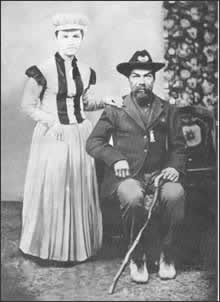
[Image above: Disabled Union Army veteran Peter Mitchell, of the 7th Maine Volunteer Regiment, with his wife, Alice; found here.]

Thursday, July 20, 2006

An incomplete list of disabled MPs

Natalie Bennett wonders, "There must have been disabled early modern MPs - certainly you’d think after all that Civil War fighting. Anyone know any?" The Guardian article she cites mentions Henry Fawcett (MP 1864-1874; he was blind), and the noted 19c. Irish MP Arthur Kavanagh, who was "born with vestigial arms and legs."

How can I resist tracking down some answers? Thanks to the search options at the Oxford Dictionary of National Biography, I can at least list a few disabled members of Parliament from before 1900 (all found using the search combination "MP" and "leg"--just as an experiment):

Charles Stewart Hardinge (1822-1894): lost leg in a boyhood accident
MP in the 1850s

Edward Lombe (d. 1852): had a leg amputated during 1820s
MP 1826-1830

Sir James Lowther (baptised 1673, d. 1755): had a leg amputated in 1750, while he was an MP (he served in Parliament from 1694 until his death)

Thomas Boulden Thompson (1766-1828): lost a leg in naval service, 1799
MP 1807-1816

George Thomson (bapt. 1607-1691): lost a leg in 1644 battle
MP 1640s-1650s

Sir Brook Watson (1735-1807): lost a leg to a shark bite while in the Navy
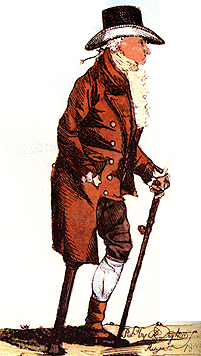
MP 1784-1793 (image above is an 1803 etching of Watson, made by Robert Dighton)

Sir Richard Weston (1578/9-1658?): "pronounced lameness" on his left side
MP 1640s