The next was a receipt from a graduate nurse who had been engaged to nurse a little hunchback boy through a severe attack of measles, in one room in an alley down on N. 10th St. This boy has long been a patient of the Orthopedic Department, and when he contracted measles and it was impossible to put him in the contagious ward of the Children's Hospital because of its over-crowded condition, the only solution of the problem of his cure seemed in securing a private nurse. The mother, a foolish sort of person, was utterly unable to look after him. On account of his bad back it seemed inadvisable to send him out to the City Contagious Hospital. A few days' expert care in his own home pulled him through the worst of his trouble, and the mother, after watching the nurse and being instructed by her, was able to go on with his care. The Provident Association met the emergency of the mother's being obliged to give up her work, by sending provisions and coal, and as soon as all danger of contagion was over, the boy was brought back to the hospital, from there to be sent to the Convalescent Home.--from Julia C. Stimson, "An Actual Day's Work," First Annual Report of the Social Service Departments (St. Louis Children's Hospital), 1912
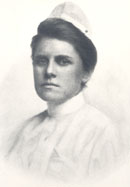 Julia C. Stimson (1881-1948), nurse and social worker, would later serve as head of the Red Cross Nursing Service and chief nurse of the American Expeditionary Forces during WWI, superintendent of the Army Nurses Corps, first dean of the Army School of Nursing, and president of the American Nurses Association. I ran across the above extract because today (May 26) is the 125th anniversary of Stimson's birth.
So, the "little hunchback boy" was sent home to be nursed through his measles, but then was returned to the orthopedic department or convalescent home when he was no longer contagious? It sounds like his "foolish" mother was able to care for him, after some instructions from a nurse, and some material relief for her lost wages. Annual reports are full of such stories--just enough to be intriguing, and/or frustrating, in their missing details. This essay by Stimson starts with mention of a "special investigation on cripples." It goes on to describe appointments with families whose children have polio and spinal tuberculosis, and a meeting with a brace maker:
He wanted to know whether he was to go ahead with the celluloid jacket and brace for a little Italian boy in the ward who three years ago had been shot in the back and had been unable to move below the waist ever since. The doctors wanted to put this apparatus on the boy but his parents were unable to pay for it. The brace maker was told to go ahead with the order, as the interest of a special Sunday School class had been enlisted and they had agreed to be responsible for the cost.If Stimson isn't exaggerating, nearly her entire workday involved finding care, placement, and funding for children with disabilities.


2 comments:
I agree with you. good job. i have a ed hardy online store, I offer great brands at great prices.you may buy the ed hardy womens shirt in discount price these days .it's good gift for your girl . the best hot item is spyder jackets in the autumn.but some guy think the cheap columbia jackets better.
The word "shanzhai" is very popular in China. It is industry phenomenon of imitation, high quality and low price. Moreover, cell phones are the representative of them.The global financial crisis led to a significant shrinkage of assets for people. "china wholesale" demonstrate the might. most of them would like buy the cheap cell phones now .
Through google search engine, when you put in "discount cell phones", you will find more than 15,000 pieces of related information. Cell phone china has been concerned in the world. Many international sellers can get a considerable profit by ways of wholesale cell phones from China and switch selling. So it is a very good job on cell phones wholesale in the current financial crisis.
Post a Comment