I am pleased to inform you that this afternoon the NYU Child Study Center
announced that they will be ending the "Ransom Notes" ad campaign in response to widespread public pressure from the disability community. You can read that
announcement here. The thousands of people with disabilities, family members,
professionals and others who have written, called, e-mailed and signed our
petition have been heard. Today is a historic day for the disability community.
Furthermore, having spoken directly with Dr. Harold Koplewicz, Director of the
NYU Child Study Center, I have obtained a commitment to pursue real dialogue in
the creation of any further ad campaign depicting individuals with disabilities. We applaud the NYU Child Study Center for hearing the voice of the disability community and withdrawing the "Ransom Notes" ad campaign.
Showing posts with label advertising. Show all posts
Wednesday, December 19, 2007
No more Ransom Notes
Happy news today (via Stephen Drake) from Ari Ne'eman of the Autistic Self Advocacy Network:
Labels:
advertising,
autism,
disablism
Wednesday, June 13, 2007
Unnecessary Roughness

Do we really need this? At left, a print ad for the 2006 Canadian Wheelchair Rugby Championship. (Visual description: black lettering on the face of what appears to be a seriously play-worn wheelchair-rugby wheel, reading "TO PLAY WHEELCHAIR RUGBY YOU HAVE TO BE PHYSICALLY HANDICAPPED AND MENTALLY INSANE.")
The other two ads in the campaign were okay, but this one plays into the cliched idea that being "mentally insane" is all about being heedless of danger, spectacularly self-destructive, and ... entertaining to watch? Busting cliches about one disability group by reinforcing cliches about another disability group just isn't helpful, in the bigger picture.
Labels:
advertising,
Canada,
sports,
wheelchair
Sunday, June 03, 2007
SDS, Day 3--short report
I had to depart the conference after lunch on Day 3, so I was only able to attend one panel--but it was a good one. If I had missed my flight to see David Linton's talk and eat mango cheesecake, it would have been absolutely worth it.Linton's talk was about the use of "handicap"/sickness/cure language in Kotex advertisements of the 1920s--he had the room (which was spilling into the hallway) gasping and exclaiming with his visuals, many of them found at Duke University Archive's wondrous Ad*Access site (part of the Digital Scriptorium). At left, one of his examples: "A Great Hygienic Handicap that Your Daughter will be Spared," reads the headline on this 1926 ad, illustrated by a drawing of two seated women (presumably mother and daughter), slim and in stylish dress, clasping hands as if they're having an important talk ("the talk," as Linton put it). The small-print text extols how "Like most things, woman's greatest hygienic handicap has yielded to modern scientific attainment."
Linton had the deadpan vocal delivery of a presenter on This American Life, too, where lighter hilarity wouldn't have served the topic--after all, these aren't just quaint old advertisements, if you remember what terms like "hygiene" and "modern scientific attainment" were also about in 1920s America, in the heyday of eugenics and Americanization. (Linton is also known, on excellent authority, as "the funkiest man on skates," a claim that nobody could challenge after Friday night's dance--and he wasn't even wearing skates at the time.)
Labels:
advertising,
conference,
hygiene,
linton,
SDS
Tuesday, October 24, 2006
Campaign Ads and Disability Politics
So there's plenty of chatter about the Michael J. Fox ad about stem cell research, airing in Missouri in support of the Democratic candidate, Claire McCaskill. Whatever position you take on the stem cell issue or the Senate race in Missouri, there are some really disturbing responses to Fox's appearance in this ad. Rush Limbaugh says "he was acting." Other commentators have said the ad is "exploitative"--implying that Fox is somehow unable to choose to speak in a political debate? -- or "in poor taste"--apparently because it's rude to be visibly disabled? (You'd think Ugly Laws were still being enforced.) ImFunnyToo has two posts commenting on the ad and its reception. Zephyr and Mark Siegel weigh in too.
But meanwhile in other political ad news, I found this one: Thug Voter, by Josh Miller and Taras Wayner, isn't new (it seems to have been made in 2004, as one of MTV's Choose or Lose spots), and it isn't easy to watch (or listen to; image at left is a still from the video), but it's one that actually links racism, sexism, homophobia, and disablism in a thirty-second punch.
There are surely others. Keep watching and listening.
But meanwhile in other political ad news, I found this one: Thug Voter, by Josh Miller and Taras Wayner, isn't new (it seems to have been made in 2004, as one of MTV's Choose or Lose spots), and it isn't easy to watch (or listen to; image at left is a still from the video), but it's one that actually links racism, sexism, homophobia, and disablism in a thirty-second punch.There are surely others. Keep watching and listening.
Labels:
advertising,
campaign ads,
Michael J. Fox,
Parkinson's,
politics
Wednesday, September 27, 2006
Mac's "Accident"

So Stephen Kuusisto and Wheelchair Dancer have weighed in so far about the new "Accident" ad from Mac, in which the PC played by John Hodgman is seen in a wheelchair, with two arms and a leg in casts, explaining that someone tripped over his power cord. (There's a still shown at right; the video version is at YouTube.) It's meant to point out that Macs have a magnetic cord attachment that easily detaches when tugged. But...hmmm. They're still playing with the wheelchair = broken cliche. I agree with Wheelchair Dancer that they're trying really hard to emphasize the "injury," not the "disability"--thus the giant plaster casts. But still.
Beth Haller pointed out an alternative in 2001: An award-winning Cingular Wireless ad aired during the Superbowl that year featuring Dan Keplinger, an artist who uses a wheelchair. There, the message was about self-expression, changing attitudes, adjusting expectations upward, and embracing the new. It can be done.
Labels:
advertising
Thursday, July 13, 2006
Go Park Yourself
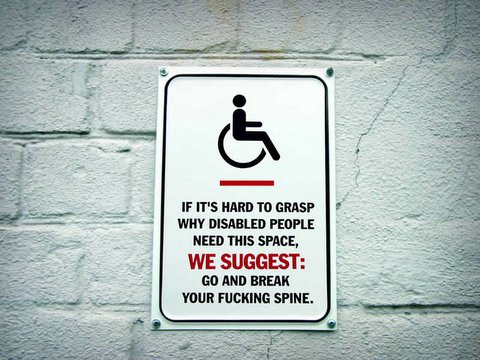
Found this via Stay Free!, a blog and zine that critiques advertising and marketing.No one seems quite sure who created this series of extremely blunt parking signs, but the photos are circulating among advertising bloggers. Anyone know where they started? Are they really posted in parking lots? Kinda hard to imagine the one I've included at right being suitable for many public locations... but gentle, civil signs seem not to work, either.
For an audio approach to the problem, check out the Spacehog, a British system that senses a newly parked car in the designated space and greets the driver with a custom-recorded audio message (as in "if you are parked in this space without a permit, your tires may be clamped").
UPDATE (7/14): Stay Free! now links to this blog, which says it's a translation of an award-winning Latvian ad campaign from 2004. The edgy Riga-based agency, ZOOM!, proclaims as its motto, "We hate advertising. That's why we make it." Reading around on their site (which is in English), you find this isn't their only work on disability themes. In 2005 they did a drunk-driving campaign in cooperation with Apeirons, a Latvian disability rights organization, called "Drink. Drive. Join." Part of the campaign involved pwds distributing x-rays of broken spines to DUI violators. It's online here (in Latvian, but you get the flavor--one of the print images is at right).
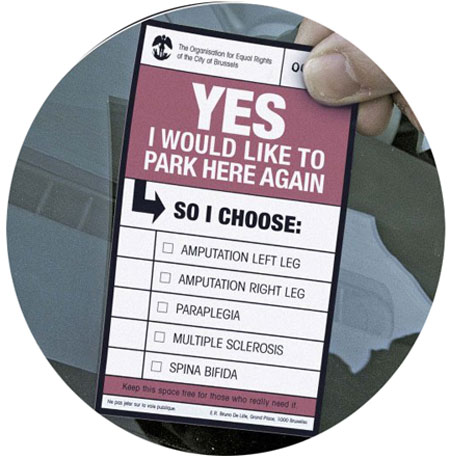
And ad-blogger Coolzor found another campaign--this time by the Organization for Equal Rights of the City of Brussels--"tickets" placed on windshields of illegally parked cars. (A closeup of the ticket is shown at left. Click to read the fine
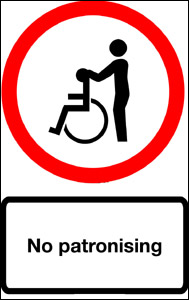
print.) Coolzor also has translations of a French campaign, called Pain without Borders (Douleur sans Frontieres), which attempt to convey the physical experience of pain from a landmine injury, from napalm burns, from an appendectomy performed under conditions that mirror torture.UPDATE (7/18): Scott Rains points out another fine series of disability road signs, by Caroline Cardus. Here's one, at right...
Labels:
advertising,
parking,
signage
Subscribe to:
Posts (Atom)