Thursday, April 12, 2007

Disability Blog Carnival #12 is up NOW!

Tokah's posted the latest edition of the Disability Blog Carnival at From Where I'm Sitting--the theme is "Disability and Culture," which Tokah threads through groups of posts about Crip Culture, Assistive Technology, Accessibility, Screen and Stage, Quality of Life, Blame, and Politics--that's a lot of coverage, and a lot of links; something for everyone, surely.

Disability Blog Carnival #13
will be hosted by Amanda at ballastexistenz on April 26. Submit using the blogcarnival.com form, or leave a comment here with your links, if that works better.

Does hosting look fun? It is--and I'm looking for hosts for May and into the summer now. Leave a comment here if you're interested. We've got several repeat volunteers willing, but new hosts are always cool too.

Monday, April 09, 2007

Spring Break Field Report: The Torrance Treehouse

Torrance, California, comes in for no end of mockery. It's called "Borrance" by some, and music fans may remember director Spike Jonze's ironic "This is for Torrance!" shout-out from the podium at the MTV Music Awards a few years back. Torrance is where Quentin Tarantino grew up. A lot of high-school scenes in movies and television are filmed in Torrance, for some reason.

So, it's hardly a destination on par with Disneyland for the first day of Spring Break. But it's closer (it's the next city over), it's cheaper, and it's got "the first universally-accessible treehouse in a public space in California"--which is what we went to check out today. The treehouse was funded by the Annenberg Foundation, designed and constructed by the national non-profit Forever Young Treehouses in collaboration with the local non-profit Pediatric Therapy Network. It's in Charles H. Wilson Park, which also features a skatepark, tennis courts, batting cages, basketball courts, a baseball diamond, a hockey rink, a duckpond, picnic areas with grills, and a playground near a large open field with a hill. (The playground is not even a little bit accessible--it's built in sand, for one thing.) On Tuesdays and Saturdays, you'd also find a bustling farmers' market in the parking lot nearby. (Stop at the pupusa stand for lunch. I always do.)

The treehouse was made with environmental sensitivity in mind, according to the Annenberg website:

The treehouse decking is made of stamped, sustainably-harvested South American Ipe wood, and the oak posts were recovered and repurposed from fire-damaged forests in southern Oregon and trees damaged by grazing horses. The wooden branches in the arbor are recycled; they would normally have been chipped or thrown away in the logging process. The helical pier foundations are among the most environmentally sound methods for placing posts near living trees. The design and placement of the treehouse will enable the adjacent trees to grow unimpeded.
There are many photos of the 2500-square-foot treehouse online here (including the photo above).

The on-the-scene report: it's still in great condition after a year's use. Accessibility isn't just accomplished with the no-steps, no-ladders entry--there are also wide smooth walkways throughout, and sturdy railings. It's "just" a treehouse--no built-in toys or anything--but it's big, and most of the kids who play there seem to get a kick out of chasing each other around the structure. The wider "rooms" would be fun places for a group of children to sit together for a circle time. I liked that there were parts that were very shady, and parts that were sunny--nice variety there. It's not especially close to any parking, though the parking area for the park itself is large and otherwise accessible.

So, if you're feeling the need for a treehouse and you happen to be within a few miles of LAX, it seems Torrance is the place. (And I'm stunned to learn that Nay Aug Park, in the city of my birth, Scranton PA, is the process of getting an accessible treehouse from the same designers--hmm!)

Saturday, April 07, 2007

"Convalescence and California: The Civil War Comes West"

From a post today on H-California (wish I could make this lecture--but I'll be at a conference in San Francisco):

The Department of History at CSU Northridge will hold the annual W.P. Whitsett Lecture in California and Western history on Friday, April 20th at 8 p.m. in the Grand Salon of the University Student Union at CSU Northridge. Professor William Deverell, Director of the Huntington-USC Institute on California and the West and Professor of History at the University of Southern California, will lecture on "Convalescence and California: The Civil War Comes West".

The public is invited. The lecture will be followed by a reception. Since seating is limited, please call the Department of History at 818-677-3566 to make a reservation and to obtain information on parking.

Professor Deverell has a forthcoming study on The Redemptive West: Convalescence, Healing, and the Post-Civil War Nation. His Whitsett lecture will explore several themes from this study, most notably the extent to which soldiers and their families, their lives shattered by the war, looked to California for hope and rejuvenation, just as the nation looked to the far West for national redemption.
Postscript: While looking up links for this post, I came across an interesting photo collection online: they're images of the 75th reunion at Gettysburg in the summer 1938. Surviving Civil War veterans (and they must all have been in their 90s) from across the United States, Confederate and Union alike, took buses and trains to Gettysburg for a last gathering. The photos are moving, and a great many of them include men in wheelchairs, or with canes. (I've been in Gettysburg in July a couple times--it was really steamy, miserably hot and humid--I hope the tent city that was erected for the reunion was more comfortable for all those old veterans.)

April 7: Alison Lapper (b. 1965)


Happy 42nd birthday to English artist Alison Lapper (pictured at right), born on this date in 1965.

She's perhaps best known as the subject of the Marc Quinn statue, "Alison Lapper Pregnant," a larger-than-life marble which has stood on Trafalgar Square's "Fourth Plinth" since 2005. This month, it's scheduled to be taken down, and replaced with another work of public art (so those of us who never got to London to see it are out of luck). The statue was featured on Ouch! podcast #4--how do you feature a statue on an audio program? I'll say only that a megaphone was possibly involved.

There's an edited excerpt from Lapper's autobiography, My Life in My Hands (Simon and Schuster 2005), online here, concentrating on her childhood in a residential hospital, and her young adult years, seeking independence, education, a career, love, the usual stuff.

Wednesday, April 04, 2007

RIP: J. Kutty (1984-2007)

Noted Tamil performer J. Kutty has died, after a fall at a hotel in Paramakudi. Kutty, born Philip Breet Mankoshy, was just 23 years old. He is best known for his role in "Dancer," a 2005 Tamil film about a one-legged dancer, based in part on his personal story. Kutty lost his own right leg in a motorcycle accident in 1998. He was in Paramakudi to perform at a temple festival with an arts ensemble.

Monday, April 02, 2007

April 2: Thomas Rhodes Armitage (1824-1890)


The very defect of sight, which proved an insuperable obstacle in the career which I had chalked out for myself, has peculiarly fitted me for a new and more extended sphere of usefulness.

--Thomas Rhodes Armitage
Today marks the birthday of British doctor Thomas Rhodes Armitage, born on this date in 1824. He is best remembered as founder of the Royal National Institute of the Blind (RNIB). Armitage trained as a doctor, and worked in medicine for years, including a stint in Turkey during the Crimean War. He married in 1860 and had two sons and a daughter.

Armitage (shown above left, in a sepia-toned portrait found here) left his medical practice in 1866, when he could no longer see well enough to read printed text. From then, he became interested in the various possible systems of raised type. As founder of the "British and Foreign Society for Improving the Embossed Literature of the Blind," he was among those who popularized Louis Braille's six-dot system as the standard for producing literature for blind readers. Armitage was also concerned with employment for young blind men, and promoted vocational training in such fields as piano tuning to improve their chances of finding work. He raised funds to open the Royal Normal College for the Blind in 1872. His books included The Education and Employment of the Blind (1871, 1886) and The Condition of the Blind in Great Britain and Ireland (1878).

Flora Annie Steel, "Prince Half-a-Son" (1894)


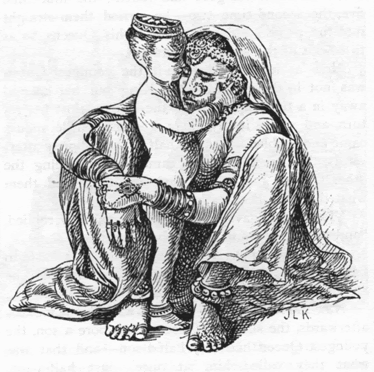
Poking around some old children's storybooks online today (there are a lot of them from the 19th century, because they're in the public domain, and have wide appeal), I found Flora Annie Steel's Tales of the Punjab (1894), a collection of folktales Steel gathered during her two-decade stay in India as a British civil servant's wife. It's probably no surprise that a collection of folktales from any culture will include some disability themes; check out "Prince Half-a-Son," for example:
...the youngest Queen had only half-a-son—and that was what they called him at once,—just half-a-son, nothing more: he had one eye, one ear, one arm, one leg; in fact, looked at sideways, he was as handsome a young prince as you would wish to see, but frontways it was as plain as a pikestaff that he was only half-a-prince. Still he throve and grew strong, so that when his brothers went out shooting he begged to be allowed to go out also.
This prince uses his unusual body to become a hero against all expectations: for example, he can slip through fences that his brothers cannot (his magic power over rope also comes in handy). His brothers push him in a well, but he's small enough to hide well and overhear a serpent and pigeon discussing their own magic powers. In the end, he wins the hand of a beautiful princess in marriage, and his mocking, jealous brothers are all eaten by a demon.

So there.

[The illustration of Prince Half-a-son above, by J. Lockwood Kipling, is from the original 1894 edition of Steel's Tales of the Punjab, and is included in the online versions linked above. By way of description, it's a line drawing of a woman in traditional Indian clothing and jewelry, seated on the ground embracing a little boy in profile. Illustrator J. L. Kipling was the father of author Rudyard Kipling, whose works he also illustrated.]