Two big projects in US disability history are launching into the world today:
Today's the release date of Kim Nielsen's A Disability History of the United States (Beacon Press 2012), a concise (272 pages!), inexpensive (just $16 in hardcover!), and sweeping account, starting before 1492, and landing in the present-day. If this is exactly the book you've needed for a class, for a book group, for your own study, you're not alone. I've only been reading in disability history for seventeen years, but back in the 1990s, you'd be lucky to find a text that even acknowledged the existence of disability before Samuel Gridley Howe's 1848 report to the Massachusetts legislature. (All my graduate projects had colonial and Early Republic settings, so I noticed.) So for that aspect alone, let alone all the other goodness involved, I'm thrilled to greet this book.
Also--DVR alert--start popping the popcorn and dimming the lights! Tonight is the first night of Turner Classic Movies' month-long feature, "The Projected Image: A History of Disability in Film." More than twenty films, various eras and genres, all with disability themes, airing all five Tuesdays in October. Lawrence Carter-Long will co-host the series with Ben Mankiewicz. Tonight's lineup: An Affair to Remember (1957); Patch of Blue (1965); Butterflies are Free (1972), Gaby-A True Story (1987), and The Sign of the Ram (1948). All with closed captions, all with audio description. It's a big deal that a cable network is devoting this much time to disability history and culture, and to make it accessible too; if you don't get TCM, consider calling your cable company and just subscribing for October. That'll be great for you (20+ movies on disability themes, plus the rest of their lineup), and it'll send a signal that this kind of programming is appreciated.
Also, if anyone wants to see a discussion feature here on DSTU, for either Kim Nielsen's book, or the TCM Film Series, I'm game. Just holler in comments, and I'll be glad to set that up. Otherwise, the hashtag for twitter discussions of the film series is #ProjectedImageTCM, and TCM has its own discussion boards that are certainly available for the purpose.
ETA: Here's a podcast interview with Kim Nielsen about the new book.
Showing posts with label television. Show all posts
Showing posts with label television. Show all posts
Tuesday, October 02, 2012


Tuesday, July 24, 2012
Press Release: The Projected Image: A History of Disability in Film
Check this out! Full press release is here.
Release Date: 7/24/2012
TCM to Examine Hollywood's Depiction of People with Disabilities in The Projected Image: A History of Disability in Film in October
Lawrence Carter-Long Joins TCM's Robert Osborne for Historic Month-Long Film Exploration, Presented in Collaboration with Inclusion in the Arts
Turner Classic Movies (TCM) will dedicate the month of October to exploring the ways people with disabilities have been portrayed in film. On behalf of Inclusion in the Arts, Lawrence Carter-Long will join TCM host Robert Osborne for The Projected Image: A History of Disability in Film. The special month-long exploration will air Tuesdays in October, beginning Oct. 2 at 8 p.m. (ET).
TCM makes today’s announcement to coincide with the 22nd anniversary of the signing of the Americans with Disability Act (ADA) on July 26. And in a first for TCM, all films will be presented with both closed captioning and audio description (via secondary audio) for audience members with auditory and visual disabilities.
The Projected Image: A History of Disability in Film features more than 20 films ranging from the 1920s to the 1980s. Each night's collection will explore particular aspects, themes, or types of disability, such as blindness, deafness and psychiatric or intellectual disabilities. In addition, one evening of programming will focus on newly disabled veterans returning home from war.
TCM's exploration of disability in cinema includes many Oscar®-winning and nominated films, such as An Affair to Remember (1957), in which Deborah Kerr's romantic rendezvous with Cary Grant is nearly derailed by a paralyzing accident; A Patch of Blue (1965), with Elizabeth Hartman as a blind white girl who falls in love with a black man, played by Sidney Poitier; Butterflies Are Free (1972), starring Edward Albert as a blind man attempting to break free from his over-protective mother; and Gaby: A True Story (1987), the powerful tale of a girl with cerebral palsy trying to gain independence as an artist; Johnny Belinda(1948), starring Jane Wyman as a "deaf-mute" forced to defy expectations; The Miracle Worker (1962), starring Anne Bancroft as Annie Sullivan and Patty Duke as Helen Keller; One Flew Over the Cuckoo's Nest (1975), with Jack Nicholson as a patient in a mental institution and Louise Fletcher as the infamous Nurse Ratched; The Best Years of Our Lives (1946), the post-War drama starring Fredric March, Myrna Loy and real-life disabled veteran Harold Russell; and Charly (1968), with Cliff Robertson as an intellectually disabled man who questions the limits of science after being turned into a genius.
The Projected Image: A History of Disability in Film also features several lesser-known classics ripe for rediscovery, including the atmospheric Val Lewton chiller Bedlam (1946), the intriguing blind-detective mystery Eyes in the Night (1942); A Child is Waiting (1963), with Burt Lancaster and Judy Garland; the British family drama Mandy (1953); and a bravura performance by wheelchair user Susan Peters in Sign of the Ram (1948).
Each year since 2006, TCM has dedicated one month toward examining how different cultural and ethnic groups have been portrayed in the movies. Several of the programming events have centered on Race and Hollywood, with explorations on how the movies have portrayed African-Americans in 2005, Asians in 2008, Latinos in 2009, Native Americans in 2010 and Arabs in 2011. TCM looked at Hollywood's depiction of gay and lesbian characters, issues and themes in 2007.
"The Projected Image: A History of Disability in Film is a valuable opportunity to take a deeper look at the movies we all know and love, to see them from a different perspective and to learn what they have to say about us as a society," said Osborne. "We are very proud to be working with Inclusion in the Arts on this important exploration. And we are especially glad to have Lawrence Carter-Long of the National Council on Disability with us to provide fascinating, historical background and thought-provoking insight on how cinematic portrayals of disability have evolved over time."
"From returning veterans learning to renegotiate both the assumptions and environments once taken for granted to the rise of independent living, Hollywood depictions of disability have alternately echoed and influenced life outside the movie theater," said Carter-Long, who curated the series. "Twenty-two years after the passage of the ADA and over a century since Thomas Edison filmed 'The Fake Beggar,' TCM and Inclusion in the Arts provide an unprecedented overview of how cinematic projections of isolation and inspiration have played out on the silver screen – and in our lives. When screened together, everything from The Miracle Worker to One Flew Over the Cuckoo's Nest reveals another layer where what you think you know is only the beginning."
Release Date: 7/24/2012
TCM to Examine Hollywood's Depiction of People with Disabilities in The Projected Image: A History of Disability in Film in October
Lawrence Carter-Long Joins TCM's Robert Osborne for Historic Month-Long Film Exploration, Presented in Collaboration with Inclusion in the Arts
Turner Classic Movies (TCM) will dedicate the month of October to exploring the ways people with disabilities have been portrayed in film. On behalf of Inclusion in the Arts, Lawrence Carter-Long will join TCM host Robert Osborne for The Projected Image: A History of Disability in Film. The special month-long exploration will air Tuesdays in October, beginning Oct. 2 at 8 p.m. (ET).
TCM makes today’s announcement to coincide with the 22nd anniversary of the signing of the Americans with Disability Act (ADA) on July 26. And in a first for TCM, all films will be presented with both closed captioning and audio description (via secondary audio) for audience members with auditory and visual disabilities.
The Projected Image: A History of Disability in Film features more than 20 films ranging from the 1920s to the 1980s. Each night's collection will explore particular aspects, themes, or types of disability, such as blindness, deafness and psychiatric or intellectual disabilities. In addition, one evening of programming will focus on newly disabled veterans returning home from war.
TCM's exploration of disability in cinema includes many Oscar®-winning and nominated films, such as An Affair to Remember (1957), in which Deborah Kerr's romantic rendezvous with Cary Grant is nearly derailed by a paralyzing accident; A Patch of Blue (1965), with Elizabeth Hartman as a blind white girl who falls in love with a black man, played by Sidney Poitier; Butterflies Are Free (1972), starring Edward Albert as a blind man attempting to break free from his over-protective mother; and Gaby: A True Story (1987), the powerful tale of a girl with cerebral palsy trying to gain independence as an artist; Johnny Belinda(1948), starring Jane Wyman as a "deaf-mute" forced to defy expectations; The Miracle Worker (1962), starring Anne Bancroft as Annie Sullivan and Patty Duke as Helen Keller; One Flew Over the Cuckoo's Nest (1975), with Jack Nicholson as a patient in a mental institution and Louise Fletcher as the infamous Nurse Ratched; The Best Years of Our Lives (1946), the post-War drama starring Fredric March, Myrna Loy and real-life disabled veteran Harold Russell; and Charly (1968), with Cliff Robertson as an intellectually disabled man who questions the limits of science after being turned into a genius.
The Projected Image: A History of Disability in Film also features several lesser-known classics ripe for rediscovery, including the atmospheric Val Lewton chiller Bedlam (1946), the intriguing blind-detective mystery Eyes in the Night (1942); A Child is Waiting (1963), with Burt Lancaster and Judy Garland; the British family drama Mandy (1953); and a bravura performance by wheelchair user Susan Peters in Sign of the Ram (1948).
Each year since 2006, TCM has dedicated one month toward examining how different cultural and ethnic groups have been portrayed in the movies. Several of the programming events have centered on Race and Hollywood, with explorations on how the movies have portrayed African-Americans in 2005, Asians in 2008, Latinos in 2009, Native Americans in 2010 and Arabs in 2011. TCM looked at Hollywood's depiction of gay and lesbian characters, issues and themes in 2007.
"The Projected Image: A History of Disability in Film is a valuable opportunity to take a deeper look at the movies we all know and love, to see them from a different perspective and to learn what they have to say about us as a society," said Osborne. "We are very proud to be working with Inclusion in the Arts on this important exploration. And we are especially glad to have Lawrence Carter-Long of the National Council on Disability with us to provide fascinating, historical background and thought-provoking insight on how cinematic portrayals of disability have evolved over time."
"From returning veterans learning to renegotiate both the assumptions and environments once taken for granted to the rise of independent living, Hollywood depictions of disability have alternately echoed and influenced life outside the movie theater," said Carter-Long, who curated the series. "Twenty-two years after the passage of the ADA and over a century since Thomas Edison filmed 'The Fake Beggar,' TCM and Inclusion in the Arts provide an unprecedented overview of how cinematic projections of isolation and inspiration have played out on the silver screen – and in our lives. When screened together, everything from The Miracle Worker to One Flew Over the Cuckoo's Nest reveals another layer where what you think you know is only the beginning."
Thursday, September 10, 2009
Wheelchair imagery in Lost publicity
 [Visual description: a retro-style poster with a bright green background, white stylized wheelchair with footprints leading away from it and a knife stuck into the adjacent surface. The slogan "Just don't tell him what he can't do" is in the upper right; the title "Terry O'Quinn is Locke" is in the lower right; the words "A deceitful father/a fateful accident/a mysterious island/a dangerous obsession/a powerful purpose/a terrible sacrifice/and/a suitcase full of knives" are in a box in the lower left.]
Heard about this poster this morning. The television show LOST has an eighteen-hour final season starting in January, so to keep fan interest stoked, ABC has returned to the show's elaborate online publicity/ARG universe with a series of sixteen commissioned posters. This one, by designer Olly Moss, is apparently already sold out (it was a small run of 300 original screenprints).
Interesting that the illustrator chose an empty wheelchair to represent Locke. The character Locke has only been seen using a wheelchair in two or three episodes, over five seasons. According to his backstory, he used a wheelchair for four years, after a dramatic fall injured his spine; his ability to walk is miraculously restored in the plane crash that starts the show's story. Only a few of the other characters know he ever used a wheelchair, and it's not a very frequent topic of dialogue. Locke has a wide array of experiences and traits that get more screentime, but it seems he's still "the former wheelchair user" above all, maybe because disability can be just that overwhelming an element of identity sometimes.
That said, I do kinda like the retro look of this poster. It presents Locke as an edgy Steve McQueen-ish film hero, with "a suitcase full of knives"--and the wheelchair as part of his "dangerous" and "mysterious" complicated backstory--well, at least it's not pitiful.
Tuesday, February 24, 2009
Cerrie Burnell's Arm

The BBC recently introduced new presenters on their popular children's show, CBeebies: Alex Winters and Cerrie Burnell. They're pictured at left, in a publicity still. Both young, white, conventionally attractive, with big grins for the camera. They're dressed in kid-friendly purple and green sweaters, sitting on a comfy couch with satiny pillows. And Cerrie has a noticeably short arm, ending just below the elbow.
Well, that last detail of the picture is apparently a problem for some parents. They say her appearance is "unsuitable" for a children's show, that the sight of her will "scare" children, even to the point of giving them nightmares. Complaints have been filed. Message boards on the subject brim with panic and ignorance. And it is the parents' problem, not the kids' concern: as Lucy Mangan writes about physical difference in a Guardian editorial on the subject, "To a young child, it is just another element of a large and confusing world that they want to inquire about, no more fearsome or embarrassing than any other."
So, of course kids are going to ask, that's what they do--and they're going to take their cues from how their parents answer those questions. Not just the words, either, but the tone, the body language--I posted some tips here a few years ago.
And think about this--if you're telling your children this lovely young woman is too frightful to behold, what are you telling them more generally about beauty? about perfection? What kind of impossible box are you asking them to fit into, and stay inside, for your approval?
Monday, January 12, 2009
What I should be writing about....
...but I'm not, because my connection is so unpredictable--a blog entry with links would take hours to assemble, during most parts of the day. I'm going to try a quick one here, at night, when the connection seems to work better. I'd like to be covering...
- The petition against a humanitarian "Oscar" for Jerry Lewis (but Andrea Shettle's got it covered, and Shelley Tremain too)
- Accessibility (or lack thereof) at the Inauguration next week (Ruth Harrigan has a round-up)
- Peter Dinklage on last week's episode of 30 Rock (which was terrific--Beth Haller has the story, with a photo)
- Blogger Kristina Chew's departure from Autism Vox, and arrival at Change.org
- The book I'm reading, April Witch by Majgull Axelsson (a Swedish novel, title character is disabled, living in a longterm nursing facility, lots of first-person observations on independent living, hospital life, being the object of pity, disgust, disbelief, manipulation, etc.)
- The book I read before this one, Riven Rock by T. C. Boyle (historical novel based on the real lives of Stanley McCormick and Katharine Dexter McCormick; Stanley's bouts of "derangement" were managed by various treatments, and by isolation on an estate in Montecito, California, supported by his family's wealth and monitored by his wife Katharine for decades)
- New playground in my neighborhood that's almost kinda-sorta accessible (photo to follow), and adventures in commenting at a nearby town's planning council meeting, where the question was "accessible playground or roller hockey?" (They decided, not wanting to disappoint any of the commenters, to have both, against some daunting limitations of space, but at least it's still under discussion.)
Sunday, November 30, 2008
November 30: Linda Bove (b. 1945)
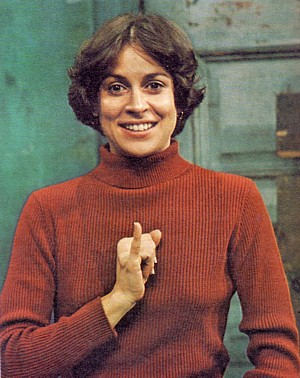 [Visual description: Linda Bove in the 1970s, wearing a rust-colored turtleneck and signing "I"]
When I joined the cast I found the writers would write about 'How would a deaf person do this?' 'How does a deaf person do that?' And it was just related to my deafness and it didn't feel like they were treating me as a person. I found my character one-dimensional and kind of boring. It showed how brave a deaf person was to do this and that in everday life. I said it was no big deal. I have a sense of humor; why don't you show that? I can be angry over something. Show that I can have a relationship with another person.
Today is the birthday of Linda Bove, born on this date in Garfield, New Jersey. If you were a hearing American kid in the 1970s, chances are the first place you saw American Sign Language was on Sesame Street--and chances are, it was being used by Linda Bove, one of the show's longest-running cast members (1972-2003). Bove attended Gallaudet University and became involved in theater as a student; she toured with the National Theater of the Deaf, and co-founded the Little Theater of the Deaf and Deaf West Theatre Company.
Now, for old times' sake, video from Sesame Street, first aired in 1980, in which Olivia (Alaina Reed) and Linda sing and sign the song "Sing" (lyrics here):
Wednesday, May 07, 2008
May 8: Douglas A. Martin (1947-2003)
May 8 was the birthday of Douglas A. Martin, a leader of the disability rights movement in Los Angeles in the early 1970s, active in Californians for Strong Access, and co-founder and director of the Westside Center for Independent Living in 1975. In 1971, he was the first grad student with a "significant disability" to win a UCLA Chancellor's Fellowship--and the next year he was UCLA's first disabled teaching assistant. He earned a PhD in urban studies at UCLA. Martin co-founded the Chancellor's Advisory Committee on Disability in 1983, and was a Special Assistant to the Chancellor to coordinate ADA and 504 compliance on campus. On the national level, he lobbied tirelessly to remove work penalties from Social Security provisions. Martin died way too soon, in 2003, at age 55.
There's a really good, long, interesting oral history interview with Douglas Martin, conducted in 2002 by Sharon Bonney, available in transcript at the Bancroft Library website. (There are also audio and video clips. This might be limited access, I'm not sure.) One section that particularly caught my eye was about his three years in an Omaha hospital after contracting polio at age 5; television was new then, and a great distraction for a ward full of children in iron lungs. But the Army-McCarthy hearings were running on the only channel for much of the day! Martin remembers that planting a seed:
What have you seen--or not seen--on TV during hospital stays?
There's a really good, long, interesting oral history interview with Douglas Martin, conducted in 2002 by Sharon Bonney, available in transcript at the Bancroft Library website. (There are also audio and video clips. This might be limited access, I'm not sure.) One section that particularly caught my eye was about his three years in an Omaha hospital after contracting polio at age 5; television was new then, and a great distraction for a ward full of children in iron lungs. But the Army-McCarthy hearings were running on the only channel for much of the day! Martin remembers that planting a seed:
It just really gave me a sense of, there's a whole big wide world out there going on, and you know this political world and all this stuff. It was interesting. Didn't have that much to do with it at that point except take it all in. But later I guess, it might have been part of the reason I was interested in politics, and getting involved in Washington, and kind of having knowledge. There was so much information and detail about the system, and how it worked and how it didn't work, in those days. Some of the best and some of the worst in people in politics came out. It was fascinating, and I guess I got interested, I saw it to be a place where you could make a difference. I kind of filed it away in the back of my mind. I kind of remember that as possibly motivating, as some basis for later interest in trying to bring about social change, something more positive. (here)I don't watch TV if I can help it when I'm in the hospital. When my kid is hospitalized, it's usually in a shared room, and there's little choice. I remember being in a quad isolation room with him during the 1998 Clinton impeachment hearings; the mother across the room was shouting at the commentators a lot. Think I also saw an Olympics opening festivities in a PICU once? I know another mother whose son was born in July 1969--so she and the other women giving birth that week were among the Americans who did not see the Neil Armstrong moon landing live.
What have you seen--or not seen--on TV during hospital stays?
Wednesday, March 19, 2008
March 20: Fred Rogers (1928-2003)
 [Image description: Mr. Rogers, at his closet, with one arm raised as he dons his familiar red cardigan]
"You are an important person just the way you are."This Thursday would have been Fred Rogers's 80th birthday. In observance of the date, the City of Pittsburgh (Rogers's homebase) is inviting folks everywhere to wear their favorite sweater -- if you have one, a zippered cardigan would be most appropriate -- and send in a photo or video. Here's a video explaining "Won't You Be My Neighbor?" Day.
Fred McFeely Rogers wasn't disabled, but for many American children, his show was an early introduction to people with disabilities, adults and children, as "neighbors"--ordinary, interesting, full members of the community. Longtime cast members on Mister Rogers' Neighborhood included Chef Brockett (played by the late Don Brockett), owner of Brockett's Bakery, who sometimes talked about his physical disability (he had a visible limp); and Mayor Maggie (played by Maggie Stewart), who was a professional ASL interpreter as well as a town executive. Violinist Itzhak Perlman was a guest on Rogers's show, and later played at Rogers's funeral, expressing his admiration for the man.
Children with disabilities were regularly cast as Mr. Rogers's friends, and he spoke with them in the same vein of polite curiosity and spontaneous decency that he did with all his guests. (See the late Jeff Erlanger's fond remembrance of his appearance on Mr. Rogers, including clips, here.) In a well-known episode of the show, Rogers took viewers to visit Children's Hospital of Pittsburgh, to demystify the experience of hospitalization. Rogers's Let's Talk About It: Extraordinary Friends (Penguin Putnam 2000) is a picture book for very young children, featuring photos of six real kids playing, disabled and non-disabled, with short bios of each kid in the back--so they're not just models or wheelchair users, they're real kids--pet owners and team members, who like pizza and dolls and swimming. The text of my favorite page:
"If you feel like trying to help somebody, it's a good idea to ask first. Sometimes people want help, and sometimes they don't."I'll be wearing my cardigan tomorrow.
Friday, November 16, 2007
Paging Dr. Cliche ...
The television writers are on strike. This is national news, I realize, but it's also local chatter here--I drive past the picket line at Raleigh Studios Manhattan Beach some days, it's only a mile or two from my house. I was talking to a striking writer at a small dinner gathering last night, and an assistant director who's also affected. That's LA for you. But one show's writers probably shouldn't rush back to work--if recent episodes are any indication of their mindset.
Cilla Sluga at Big Noise explained what was wrong about last week's mess on ER: an episode in which a doctor and a young teen decide the kid (who has a terminal illness) shouldn't live any longer, so they lie to the kid's mother about treatment options--and this is presented as a noble gesture on the doctor's part, not as gross malpractice. One character objects, but doesn't go farther than voicing her objection. (And as Sluga further reveals, the episode was written by an ER doctor at Children's Hospital LA--a scary twist to the story.) In this week's episode, William Peace at Bad Cripple catches another doozy: a wheelchair user is the tired "bitter cripple" stereotype, complete with lines like "anger is my baseline" (which would make a fine t-shirt, but as a summary of a disabled character, ugh). One implication of his storyline is that he can't be a good parent because, uh... because he can't clean the gutters. What?
It wasn't always like this: ER has in the past done much better by the disability community. Characters with physical, mental and sensory disabilities have been presented as rounded human beings with full civil rights, at least as well as any other 44-minute network TV drama has done (admittedly, that's a low standard to achieve). One highlight was a 1998 appearance by Neil Marcus, which was about showing disablist assumptions for the dangerous errors they are.... not about confirming those assumptions for viewers.
I hear that this is ER's last season. Maybe that's for the best.
UPDATE 12-7: William Peace notes that the 300th episode (much hyped, aired this week) was also cringe-worthy.
Cilla Sluga at Big Noise explained what was wrong about last week's mess on ER: an episode in which a doctor and a young teen decide the kid (who has a terminal illness) shouldn't live any longer, so they lie to the kid's mother about treatment options--and this is presented as a noble gesture on the doctor's part, not as gross malpractice. One character objects, but doesn't go farther than voicing her objection. (And as Sluga further reveals, the episode was written by an ER doctor at Children's Hospital LA--a scary twist to the story.) In this week's episode, William Peace at Bad Cripple catches another doozy: a wheelchair user is the tired "bitter cripple" stereotype, complete with lines like "anger is my baseline" (which would make a fine t-shirt, but as a summary of a disabled character, ugh). One implication of his storyline is that he can't be a good parent because, uh... because he can't clean the gutters. What?
It wasn't always like this: ER has in the past done much better by the disability community. Characters with physical, mental and sensory disabilities have been presented as rounded human beings with full civil rights, at least as well as any other 44-minute network TV drama has done (admittedly, that's a low standard to achieve). One highlight was a 1998 appearance by Neil Marcus, which was about showing disablist assumptions for the dangerous errors they are.... not about confirming those assumptions for viewers.
I hear that this is ER's last season. Maybe that's for the best.
UPDATE 12-7: William Peace notes that the 300th episode (much hyped, aired this week) was also cringe-worthy.
Friday, August 18, 2006
ASL, the Lost Experience, and YouTube
"The Lost Experience" is a summer ARG (alternative reality game) meant to keep fans of the ABC television series "Lost" engaged until the new episodes air in the fall. One component has been the search for clues, in the form of "glyphs," strings of characters that can be used to access seventy video fragments, which will in turn eventually be assembled into a bigger picture. Players from all over work together to solve anagrams, codes, and literary and scientific references. Clues have appeared in television commercials, on websites, on phone messages, on t-shirts and wristbands, on the display in Times Square, and yesterday, a clue appeared.... in American Sign Language, in a YouTube video. (The "glyph" is part of the symbol on the signer's shirt; the signer's message does not match the video's voice-over, but instead communicates details for the game's story.)
You can follow how the players responded to this in the comments at The Lost Experience Clues blog. It didn't take long for a few regular players with ASL fluency to be found, and online (partly in chat) they worked on a translation together--discussions have touched on problems such as the video's quality (too grainy for the fingerspelling to be easily read, even in slowed down versions), the signer's distracting attire, the close-cropping of the video (for game purposes, the signer's face cannot be shown, and the gamers have discussed how that hinders ASL communication somewhat). Some players posted slower or false-colored versions of the video, to be helpful. So, hundreds, maybe thousands (the video has been viewed over 1500 times in its first day), of Lost gamers are learning something about ASL, or using what they already know, this week.
Elsewhere on YouTube... Caughtya.org recently linked to a wicked New Zealand public service announcement about accessible parking, definitely worth a peek. There's a lot of junk on YouTube, but there's also a lot of potential, like most formats.
You can follow how the players responded to this in the comments at The Lost Experience Clues blog. It didn't take long for a few regular players with ASL fluency to be found, and online (partly in chat) they worked on a translation together--discussions have touched on problems such as the video's quality (too grainy for the fingerspelling to be easily read, even in slowed down versions), the signer's distracting attire, the close-cropping of the video (for game purposes, the signer's face cannot be shown, and the gamers have discussed how that hinders ASL communication somewhat). Some players posted slower or false-colored versions of the video, to be helpful. So, hundreds, maybe thousands (the video has been viewed over 1500 times in its first day), of Lost gamers are learning something about ASL, or using what they already know, this week.
Elsewhere on YouTube... Caughtya.org recently linked to a wicked New Zealand public service announcement about accessible parking, definitely worth a peek. There's a lot of junk on YouTube, but there's also a lot of potential, like most formats.
Subscribe to:
Posts (Atom)


