Thursday, August 18, 2005
Disability History Timeline
Have a peek at the Disability History Timeline just mounted online by San Francisco State University's Institute on Disability. It's searchable, and intended as a teaching/learning resource. They're actively seeking suggestions for additions--so go check your favorite eras and fill in some dates. (There's a special plea for more non-US items for the timeline.) I've contributed a few already, myself, drawn from the H-Disability archives.


Here we go again...
It seems like an annual thing. This year's version: a Napoleon Dynamite talking pen that says (as one of seven sayings in rotation) "You guys are retarded," marketed as just in time for back to school shopping at Target and elsewhere. At this website, they're recommended as the "perfect gift for any student." Lovely. That'll help so much with inclusion, thanks. (Gail Williamson at the Down Syndrome Association of Los Angeles is already ginning up the letterwriting campaign via email, but it's not yet on their website as I type this.)
Monday, August 15, 2005
Disability History Image, #1
 I've got a file on my desktop of disability history images, and it occurs to me that they might be something to share here, once a week or so (now that I know how to post images to a blog). They're a pretty random lot, as you'll see from this first one. It's from a Time/Life volume, titled The Northwest Passage by Brendan Lehane (Time-Life 1981), from a series called "The Seafarers." The caption tells the tale:
"Tulluahiu, who lost a leg during an encounter with a polar bear, wears a wooden limb fashioned for him by the carpenter of the Victory. The artificial leg rendered Tulluahiu 'serviceable once more to himself and his community,' noted Ross, and 'raised us higher in the estimation of this people than all the wonders we had shown them.'" (125)
The illustration is a watercolor by Captain John Ross, whose ship (the Victory) and its crew became trapped in ice on the coast of the Boothia Peninsula (the northernmost tip of the North American mainland) in 1829. The volume's picture credits say the originals are at the Scott Polar Research Institute in Cambridge, England.
There's a recent book on the Ross expedition's time on the Boothia Peninsula: Ray Edinger, Fury Beach: The Four-Year Odyssey of Captain John Ross and the Victory (New York: Berkley 2003). It's reviewed here.
Saturday, August 13, 2005
Nineteenth-Century Teachers with Disabilities
Two examples: one from a biography of Letitia Landon, born August 14, 1802:
And another, Isaac Copper, described in Frederick Douglass's autobiography:
These examples floating across my screen brought to mind the book The Teacher's Body: Embodiment, Authority, and Identity in the Academy, eds. Diane P Freedman, Martha Stoddard Holmes, Rosemarie Garland-Thomson, and Madeleine R. Grumet (SUNY Press 2003). (But that's mainly about the present-day, higher ed context.)
"Miss Landon received the first rudiments of education from an invalid friend and neighbor, who was wont to throw the letters of the alphabet over the carpet, and on the infant scholar bringing to her the right one, she received some trivial reward, which, on her return home, was displayed in the drawing room, and invariably shared with her brother, who consequently was wont to look very earnestly for the hour of her appearance."(Creative!)
And another, Isaac Copper, described in Frederick Douglass's autobiography:
"...he was called Doctor Copper. He was both our Doctor of Medicine and our Doctor of Divinity. Where he took his degree I am unable to say, but he was too well established in his profession to permit question as to his native skill, or attainments. One qualification he certainly had. He was a confirmed cripple, wholly unable to work, and was worth nothing for sale in the market. Though lame, he was no sluggard. He made his crutches do him good service, and was always on the alert looking up the sick, and such as were supposed to need his aid and counsel....I was early sent to Doctor Isaac Copper, with twenty or thirty other children, to learn the Lord's prayer. The old man was seated on a huge three-legged oaken stool, armed with several large hickory switches, and from the point where he sat, lame as he was, he could reach every boy in the room."Douglass goes on to explain that "Everybody in the South seemed to want the privilege of whipping somebody else. Uncle Isaac, though a good old man, shared the common passion of his time and country."
These examples floating across my screen brought to mind the book The Teacher's Body: Embodiment, Authority, and Identity in the Academy, eds. Diane P Freedman, Martha Stoddard Holmes, Rosemarie Garland-Thomson, and Madeleine R. Grumet (SUNY Press 2003). (But that's mainly about the present-day, higher ed context.)
Thursday, August 11, 2005
Appeal: Universal Design and Visitability Curriculum
This summer, I began consulting with an NSF-funded summer enrichment program for high school students based at Temple University called bITS (Building Information Technology Skills), wher I am introducing concepts of Universal Design and Visitability to the students.
My colleague Carol Marfisi informs me that several years ago the former chair of the Mayor's Commmission on People with Disabilities (Philadelphia) was involved in an innovative program for high school students that sent groups of students out to different neighborhoods around the city and challenged them to document the accessibility of these environments. They were provided with important tools such as odometers, and knowledge gained through this project must be invaluable. I would be interested in contacting some of the leaders of this or similar projects.
Dear readers! Do you know the names the teachers or the schools that were involved in this or similar projects? Are there any reports, papers or other media that documente this work? Are there collections of images or videos/DVDs that you recommend as training resources for my students? I am already aware of the materials made available by Eleanor Smith at Concrete Change. But I am sure there is more out there.
I hope to develop a community-based project that the students can get involved in this fall. Basic information on the program can be found at this site, http://bits.delawarevalley.org/ I look forward to helpful insights from the posts and ensuing conversations.
Sincerely, Mike
My colleague Carol Marfisi informs me that several years ago the former chair of the Mayor's Commmission on People with Disabilities (Philadelphia) was involved in an innovative program for high school students that sent groups of students out to different neighborhoods around the city and challenged them to document the accessibility of these environments. They were provided with important tools such as odometers, and knowledge gained through this project must be invaluable. I would be interested in contacting some of the leaders of this or similar projects.
Dear readers! Do you know the names the teachers or the schools that were involved in this or similar projects? Are there any reports, papers or other media that documente this work? Are there collections of images or videos/DVDs that you recommend as training resources for my students? I am already aware of the materials made available by Eleanor Smith at Concrete Change. But I am sure there is more out there.
I hope to develop a community-based project that the students can get involved in this fall. Basic information on the program can be found at this site, http://bits.delawarevalley.org/ I look forward to helpful insights from the posts and ensuing conversations.
Sincerely, Mike
Monday, August 08, 2005
Simi Linton promotes DS in the Village Voice
Village Voice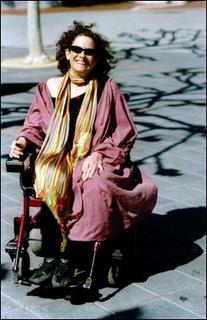 Education Supplement, Fall 2005
August 2nd, 2005 12:52 PM printer friendly
Body Politics
The wheel world: Is disability studies academia's next frontier?
by Rebecca Tuhus-Dubrow
Activist Simi Linton: “Disability studies is us looking out at the world and seeing how that looks to us.” photo: Ruth Morgan
Lest America divide too neatly into red/blue, NASCAR/latte blocs, one constituency can be counted on to muck up the dichotomy. People with disabilities defy political pigeonholing. The group considers itself an oppressed minority, and its civil rights agenda grew out of 1960s radicalism. But on issues such as euthanasia, disabled people find themselves allied with "culture of life" enthusiasts. As disability activist Simi Linton says, "A lot of disabled people justifiably feel vulnerable to ideas held by their family and the medical establishment that our lives are less valuable. . . . That is why I'm categorically opposed to physician- assisted suicide, because I think some people are more likely to be assisted than others." For secularists, this argument is a bit harder to dismiss than "because God said so."
Now disabled people have gotten into the business of problematizing: Disability studies has arrived in academia. Of course, the medical study of disability is long-standing, but the new approach establishes an interdisciplinary field on the model of women's, queer, and ethnic studies. Linton, author of the upcoming My Body Politic (Michigan), explains: "The curriculum had traditionally housed disability in a very sequestered area—how to fix people and take care of them. Disability studies is us looking out at the world and seeing how that looks to us." It also critiques "how disability is represented in all kinds of texts—in literature, film, the annals of history."
The Society for Disability Studies (SDS) was founded in 1982, with an emphasis on social science. In the early 1990s, scholars working independently in the humanities began to discover each other's work at SDS conferences. Linton, whose legs were paralyzed in a car accident in 1971, describes these conferences as "quite chaotic. You've got 50 people who use wheelchairs, you've got blind people with dogs, you've got deaf people with interpreters. . . . And we all sort of move to accommodate each other. It's a powerful experience for outsiders coming in for the first time."
Today, Syracuse, UC Berkeley, UCLA, the University of Wisconsin, and others offer programs in the field. Locally, the CUNY Graduate Center launched a certificate program last fall, consisting of four courses on the cultural and political aspects of disability, which can lead to various degrees. For the past two years, Columbia has hosted a monthly seminar for area faculty and grad students. Organized by Linton and colleagues, its topics range from disability in late capitalism to the intersection of disability and queer studies. Just last May, the field was officially recognized as a division by the Modern Language Association (MLA).
Disability scholars aim to revolutionize the way disability is imagined in our culture. Rather than pathologizing individuals, they ask how society accommodates different bodies (or doesn't). Disability, they point out, highlights the dynamic nature of identity itself: Entry into the disabled community could be a matter of an overlooked stop sign or the emergence of a lurking gene.
Anyone who's taken a women's studies class or read Edward Said will be familiar with the terms of the field. The study of disability, like that of gender, race, and sexual orientation, is rooted in bodies perceived as "other." All of these disciplines use the language of critical theory—Foucault, with his interrogations of power, the body, and pathology, is big in disability studies. And these related fields can cross-pollinate. Rosemarie Garland-Thomson, who teaches in the women's studies department at Emory University, promotes the integration of feminist and disability studies. Her scholarship reveals unsettling parallels: Women have often been conflated with the disabled, beginning with Aristotle's representation of women as mutilated men.
Disability studies may sound esoteric, but it grapples with concerns any eighth-grader can relate to. The pressure to be normal is a major theme of the research. As Garland-Thomson has written, "[T]he cultural function of the disabled figure is to act as a synecdoche for all forms that culture deems non-normative." Disability discourse often touches on bodies that stray from the norm—"freaks," but also people considered fat, ugly, or funny looking.
Although disability has fruitfully integrated with other identity studies, the field has not always received a warm welcome. Alison Kafer, who teaches feminist and disability studies at Southwestern University, attributes resistance in part to funding, but on a deeper level, she notes that "women and queers and people of color have often been cast as sick. That's how discrimination was justified." Now those minorities are saying, "You know what—we're not sick," and they shun association with people still seen as defective. The ambivalence is mutual; some disability scholars want to jump from what they see as the sinking ship of identity studies. As University of Illinois at Chicago's Lennard J. Davis pointed out in a 2004 conference paper, "We are in a twilight of the gods of identity politics, and there is no Richard Wagner to make that crepuscular moment seem nostalgic and tragic." So disability studies has arrived, but is it too late?
Despite the falling currency of identity studies, the field's institutional gains are clear, if modest. But institutionalization may not be the primary goal. As Garland-Thomson says, "We don't necessarily need people majoring or minoring in disability studies. We need to create a system in which educated people have it as a category of understanding." She observes that many canonical literary works have a neglected disability aspect: Ahab in Moby Dick is an amputee, Shakespeare's Richard III is a hunchback, and several of Toni Morrison's characters are disabled as well as black and female. "You wouldn't have to teach a class called 'Disability and Literature,' " she says. In studying literature—or any subject—disability is simply an additional lens at our disposal. In literature, Garland-Thomson has found, disability is typically reduced to a metaphor, shorthand for strangeness.
Exciting scholarship is being generated. Last March's issue of the PMLA (the MLA's publication) featured papers from a recent MLA conference, including "Deaf, She Wrote: Mapping Deaf Women's Autobiography" and "Crip Eye for the Normate Guy: Queer Theory and the Disciplining of Disability Studies." One item on the field's agenda is to welcome cognitive disabilities into the fold. SDS continues to hold annual conferences as well. "I come back from SDS so excited," says Linton. "My colleagues are the smartest people I've met, ever."
 Education Supplement, Fall 2005
August 2nd, 2005 12:52 PM printer friendly
Body Politics
The wheel world: Is disability studies academia's next frontier?
by Rebecca Tuhus-Dubrow
Activist Simi Linton: “Disability studies is us looking out at the world and seeing how that looks to us.” photo: Ruth Morgan
Lest America divide too neatly into red/blue, NASCAR/latte blocs, one constituency can be counted on to muck up the dichotomy. People with disabilities defy political pigeonholing. The group considers itself an oppressed minority, and its civil rights agenda grew out of 1960s radicalism. But on issues such as euthanasia, disabled people find themselves allied with "culture of life" enthusiasts. As disability activist Simi Linton says, "A lot of disabled people justifiably feel vulnerable to ideas held by their family and the medical establishment that our lives are less valuable. . . . That is why I'm categorically opposed to physician- assisted suicide, because I think some people are more likely to be assisted than others." For secularists, this argument is a bit harder to dismiss than "because God said so."
Now disabled people have gotten into the business of problematizing: Disability studies has arrived in academia. Of course, the medical study of disability is long-standing, but the new approach establishes an interdisciplinary field on the model of women's, queer, and ethnic studies. Linton, author of the upcoming My Body Politic (Michigan), explains: "The curriculum had traditionally housed disability in a very sequestered area—how to fix people and take care of them. Disability studies is us looking out at the world and seeing how that looks to us." It also critiques "how disability is represented in all kinds of texts—in literature, film, the annals of history."
The Society for Disability Studies (SDS) was founded in 1982, with an emphasis on social science. In the early 1990s, scholars working independently in the humanities began to discover each other's work at SDS conferences. Linton, whose legs were paralyzed in a car accident in 1971, describes these conferences as "quite chaotic. You've got 50 people who use wheelchairs, you've got blind people with dogs, you've got deaf people with interpreters. . . . And we all sort of move to accommodate each other. It's a powerful experience for outsiders coming in for the first time."
Today, Syracuse, UC Berkeley, UCLA, the University of Wisconsin, and others offer programs in the field. Locally, the CUNY Graduate Center launched a certificate program last fall, consisting of four courses on the cultural and political aspects of disability, which can lead to various degrees. For the past two years, Columbia has hosted a monthly seminar for area faculty and grad students. Organized by Linton and colleagues, its topics range from disability in late capitalism to the intersection of disability and queer studies. Just last May, the field was officially recognized as a division by the Modern Language Association (MLA).
Disability scholars aim to revolutionize the way disability is imagined in our culture. Rather than pathologizing individuals, they ask how society accommodates different bodies (or doesn't). Disability, they point out, highlights the dynamic nature of identity itself: Entry into the disabled community could be a matter of an overlooked stop sign or the emergence of a lurking gene.
Anyone who's taken a women's studies class or read Edward Said will be familiar with the terms of the field. The study of disability, like that of gender, race, and sexual orientation, is rooted in bodies perceived as "other." All of these disciplines use the language of critical theory—Foucault, with his interrogations of power, the body, and pathology, is big in disability studies. And these related fields can cross-pollinate. Rosemarie Garland-Thomson, who teaches in the women's studies department at Emory University, promotes the integration of feminist and disability studies. Her scholarship reveals unsettling parallels: Women have often been conflated with the disabled, beginning with Aristotle's representation of women as mutilated men.
Disability studies may sound esoteric, but it grapples with concerns any eighth-grader can relate to. The pressure to be normal is a major theme of the research. As Garland-Thomson has written, "[T]he cultural function of the disabled figure is to act as a synecdoche for all forms that culture deems non-normative." Disability discourse often touches on bodies that stray from the norm—"freaks," but also people considered fat, ugly, or funny looking.
Although disability has fruitfully integrated with other identity studies, the field has not always received a warm welcome. Alison Kafer, who teaches feminist and disability studies at Southwestern University, attributes resistance in part to funding, but on a deeper level, she notes that "women and queers and people of color have often been cast as sick. That's how discrimination was justified." Now those minorities are saying, "You know what—we're not sick," and they shun association with people still seen as defective. The ambivalence is mutual; some disability scholars want to jump from what they see as the sinking ship of identity studies. As University of Illinois at Chicago's Lennard J. Davis pointed out in a 2004 conference paper, "We are in a twilight of the gods of identity politics, and there is no Richard Wagner to make that crepuscular moment seem nostalgic and tragic." So disability studies has arrived, but is it too late?
Despite the falling currency of identity studies, the field's institutional gains are clear, if modest. But institutionalization may not be the primary goal. As Garland-Thomson says, "We don't necessarily need people majoring or minoring in disability studies. We need to create a system in which educated people have it as a category of understanding." She observes that many canonical literary works have a neglected disability aspect: Ahab in Moby Dick is an amputee, Shakespeare's Richard III is a hunchback, and several of Toni Morrison's characters are disabled as well as black and female. "You wouldn't have to teach a class called 'Disability and Literature,' " she says. In studying literature—or any subject—disability is simply an additional lens at our disposal. In literature, Garland-Thomson has found, disability is typically reduced to a metaphor, shorthand for strangeness.
Exciting scholarship is being generated. Last March's issue of the PMLA (the MLA's publication) featured papers from a recent MLA conference, including "Deaf, She Wrote: Mapping Deaf Women's Autobiography" and "Crip Eye for the Normate Guy: Queer Theory and the Disciplining of Disability Studies." One item on the field's agenda is to welcome cognitive disabilities into the fold. SDS continues to hold annual conferences as well. "I come back from SDS so excited," says Linton. "My colleagues are the smartest people I've met, ever."
Sunday, August 07, 2005
Disability Blogs: A Roundup
Lots of topics coming up around the disability blogs... just a roundup of a few:
Others link to "Deafness in Disguise," the recent online exhibit about the history of hearing devices, but Mary Johnson goes farther, asking why glasses became no big deal, even cool in some ways, while hearing aids never have, and seem to require "disguise." She also, perceptively, critiques the advertising for laser eye surgery that tries to reinstall shame/annoyance about wearing glasses where there isn't much to start with.
Programs serving people with disabilities are shutting down all over the US. Some you'll hear a more about, like the Tennessee case reported here and elsewhere; but others, not so much. Two examples: Charmenders at Quiescent Voices noted that domestic violence survivors who are Deaf will soon have fewer options in Austin TX, when the DAWCAS (Deaf Abused Women and Children Advocacy Services) reduces its services for lack of funding. (Their federal "Victims of Crime Act" funds are being discontinued.) Madeleine Gomez Schwartz at DNNYC (a yahoogroup with an RSS feed) posted that "the External Education Program for the Homebound inQueensborough Community College is closing at the end of this month."
Sanford Hausler's FAPE Page caught the story of how Los Angeles Unified School District has "completed only a tiny percentage of renovation projects" designed to make its buildings more accessible for students with disabilities; and they're also dealing with continuing racial disparities in special education, as are the districts in Montgomery and Anne Arundel Counties in Maryland, as noted on the Disability Law blog and The Gimp Parade. The Gimp Parade also picked up on the Village Voice article about disability studies "mucking up the dichotomy"--which sounds like a bumper sticker: "Disability Studies: Mucking up the Dichotomies."
Scott Rains has details about two upcoming Universal Design conferences, in Santa Cruz CA (August 19, focus on urban infrastructure) and Woodbridge VA (September 28, focus on single-family dwellings), and suggests that a midwestern conference would also be nice to see...maybe with a focus on hotel/motel/hospitality projects. Christiane Link is questioning her German bank's strategy for advertising accident insurance. And Kim Luty has tips on buying adapted vehicles.
What are folks reading, or trying to read, or listening to? Scott Laurent at Disability is an Art has been reading The Diving Bell and the Butterfly. Meanwhile,
I'll try to do these roundups every month or so. Got ideas about what should be included? Let me know!
Others link to "Deafness in Disguise," the recent online exhibit about the history of hearing devices, but Mary Johnson goes farther, asking why glasses became no big deal, even cool in some ways, while hearing aids never have, and seem to require "disguise." She also, perceptively, critiques the advertising for laser eye surgery that tries to reinstall shame/annoyance about wearing glasses where there isn't much to start with.
Programs serving people with disabilities are shutting down all over the US. Some you'll hear a more about, like the Tennessee case reported here and elsewhere; but others, not so much. Two examples: Charmenders at Quiescent Voices noted that domestic violence survivors who are Deaf will soon have fewer options in Austin TX, when the DAWCAS (Deaf Abused Women and Children Advocacy Services) reduces its services for lack of funding. (Their federal "Victims of Crime Act" funds are being discontinued.) Madeleine Gomez Schwartz at DNNYC (a yahoogroup with an RSS feed) posted that "the External Education Program for the Homebound in
Sanford Hausler's FAPE Page caught the story of how Los Angeles Unified School District has "completed only a tiny percentage of renovation projects" designed to make its buildings more accessible for students with disabilities; and they're also dealing with continuing racial disparities in special education, as are the districts in Montgomery and Anne Arundel Counties in Maryland, as noted on the Disability Law blog and The Gimp Parade. The Gimp Parade also picked up on the Village Voice article about disability studies "mucking up the dichotomy"--which sounds like a bumper sticker: "Disability Studies: Mucking up the Dichotomies."
Scott Rains has details about two upcoming Universal Design conferences, in Santa Cruz CA (August 19, focus on urban infrastructure) and Woodbridge VA (September 28, focus on single-family dwellings), and suggests that a midwestern conference would also be nice to see...maybe with a focus on hotel/motel/hospitality projects. Christiane Link is questioning her German bank's strategy for advertising accident insurance. And Kim Luty has tips on buying adapted vehicles.
What are folks reading, or trying to read, or listening to? Scott Laurent at Disability is an Art has been reading The Diving Bell and the Butterfly. Meanwhile,
I'll try to do these roundups every month or so. Got ideas about what should be included? Let me know!
Subscribe to:
Posts (Atom)


