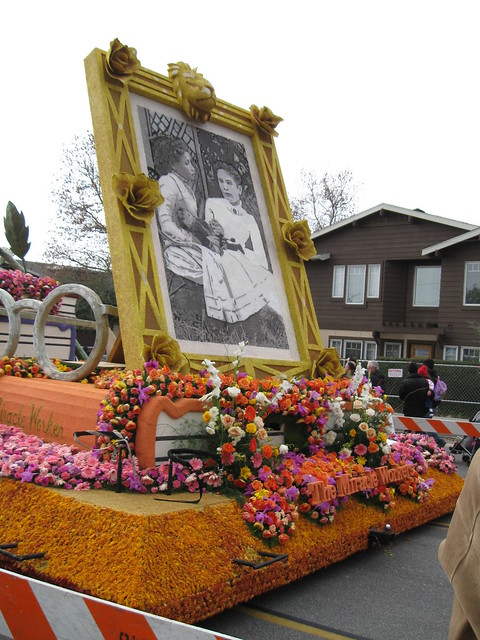
[Visual description: Photograph of a Rose Parade float in Pasadena, 2009, sponsored by the Lions Club, featuring a large framed image of Helen Keller and Anne Sullivan, with many many flowers below and "The Miracle Workers" as the caption; taken by me]
As I said when we announced we'd be participating in the
Helen Keller Mythbusting Blogswarm, we've already done
some mythbusting posts about Helen Keller here at DSTU. But another invitation in the blogswarm call suggests bloggers write about other historical women with disabilities, so that the Helen Keller story has more context. Helen Keller was unique, like any individual is, but she was obviously not the only blind woman to do anything interesting, ever, anywhere.
So here are seven more historical names for starters, all but one of them born before Helen Keller. No living women included, just to keep it historical. And I know other people will write about Anne Sullivan and Laura Bridgman for this event, so I skipped them too. I wish the list was more diverse--mostly English speakers here, and a cluster of musicians--but it's a start and I hope others will add to it.
Let the parade begin!
1.
Matilda Ann "Tilly" Aston (1873-1947) was a blind writer and teacher in Australia, founder of the Victorian Association of Braille Writers, and of the Association for the Advancement of the Blind. She is considered the first blind student enrolled at an Australian university. In addition to her writing and literacy work, she campaigned successfully for voting rights and public transit access for blind Australians. Aston edited a Braille magazine for many years, and was an enthusiastic correspondent in Esperanto.
2.
Elizabeth M. M. Gilbert (1826-1885) was an Englishwoman who campaigned for blind education and employment. Her father was a college principal and bishop, and Elizabeth (blind from age 3) was educated in languages along with her seven sisters. With an inheritance to support herself, she founded the Association for Promoting the General Welfare of the Blind, and helped to found the Royal National College for the Blind. She also lobbied for the 1870 Education Act.
3.
Fanny Crosby (1820-1915) was an American hymn writer, credited with writing over 8000 hymns (many under pseudonyms). She started as a student at the New York Institute for the Blind, and stayed on as a teacher of rhetoric and history. She had to resign at 38 when she married a fellow NYIB alumnus. Crosby played one of her own compositions at the funeral of President Grant in 1885. Said Crosby, "
If perfect earthly sight were offered me tomorrow I would not accept it."
4.
Frances Browne (1816-1879) was an Irish writer, blind from infancy. She began publishing poetry in her twenties, and succeeded well enough to move to London by 1852. She is best known for her children's book,
Granny's Wonderful Chair and Its Tales of Fairy Times, but she also wrote three novels in the 1860s.
5.
Charlotta Seuerling (1782?-1828) was a Swedish composer, writer, and musician. Charlotta's parents were both theatre professionals, so Charlotta had plenty of access to music as a child, and plenty of travel experiences too. When Per Aron Borg opened his Stockholm school for blind and deaf students in 1808, Charlotta was his first student, and her musical exhibitions were popular fundraisers. Charlotta Seuerling went on to help found the Institute for the Blind in St. Petersburg.
6.
Maria Theresia von Paradis (1759-1824) was an Austrian composer and musician, a contemporary of Mozart's. She began performing as a teenager, singing and playing organ and piano. She commissioned works by Salieri, Mozart, and Haydn, and gave concerts in London, Paris, Frankfurt, Prague, and other major European cities. Maria Theresia von Paradis is credited with helping Valentine Haüy establish the first school for the blind in Paris in 1785. She also taught singing, piano and theory at her own music school for girls in Vienna.
7.
Mary Mitchell (1893-1973) was a successful Australian writer who became blind in midlife. Faced with rapidly diminishing vision, she learned to type on a typewriter and use a dictaphone, and wrote eight more novels with them. Mitchell was vice-president of the Braille Library of Victoria. She also wrote
Uncharted Country (1963), about the practical aspects of living with blindness.
 [visual description: Disability Blog Carnival logo, featuring an old photograph of a hospital with the words "Disability Blog Carnival: Can't Shut Us Up Now" superimposed in yellow scrawly lettering]